


The tide has turned on reading instruction. Nearly all states have passed “science of reading” laws, and most researchers and educators now agree students need to learn letters and sounds explicitly and systematically to become proficient readers. The Washington Post’s editorial board recently went so far as to proclaim that the reading wars have ended. “The victor is clear: Phonics is the best way to teach kids how to read.”
And yet a look inside K–3 classrooms reveals surprising variation in exactly how these letters and sounds are taught. Along with the many research-based methods in use, there’s another practice taking hold, and at great cost to students: over-teaching.
Mark Seidenberg, a professor emeritus at the University of Wisconsin–Madison who studies reading science, helped persuade the public of the need for science-based instruction—and now he’s among those sounding the alarm on over-instruction. Reading teachers need not aim to teach every single pattern students will encounter in text, he says; they simply need to teach enough that students can achieve “escape velocity,” or the ability to start cracking the code on their own.
“You do teach them about words, about print. You teach them enough simple phonics patterns so they can start sounding out some words. And then there’s supposed to be a light bulb that goes on,” Seidenberg says.
Researchers call this ability to implicitly pick up patterns and apply them the “self-teaching mechanism,” or “statistical learning”—and many say it’s underrecognized within the science-of-reading movement.
What the Research Says—and Doesn’t Say
Five decades of research have shown that early readers benefit from learning letter-sound correspondences systematically. But little definitive evidence exists on which phonics skills should be taught, in what order, and for how long. Should students learn all of the English language’s 44-plus sounds (phonemes)? What about the 200-plus spellings that go with them? And how much time should teachers spend on each?
For instance, the ow letter pattern generally indicates the end sound in now and how. But it can also say the /ō/ (long o) sound, as in know and grow. Should teachers explicitly teach both sounds or just the more common sound? And how much time should they devote to the pattern at all?
“Some degree of explicit and systematic phonics instruction is going to be beneficial for most children,” says Nathan Clemens, professor and chair of the department of special education at the University of Texas at Austin College of Education. “How much phonics instruction they should be taught per day, when should it stop, across how many grade levels—we don’t have evidence to point to that. And we probably never will, because there’s going to be so many individual factors that will play into it.”
Each phonics program that claims to be based on research reflects a single method of instruction. These programs can differ significantly because the research on reading acquisition “is not differentiating every single skill that needs to be taught,” says Louise Spear-Swerling, professor emerita in the department of special education at Southern Connecticut State University in New Haven, Connecticut. “People write instructional programs, and it’s a matter of interpretation.”
What Does Over-Teaching Look Like?
Over-teaching affects different kids in different ways.
For the highest-achieving students who may be reading novels at home, sitting through lessons on skills they’ve mastered takes up time that could be spent reading, writing, and learning deeply about science, history, and other subjects—and it can lead to disengagement. For struggling readers, including students with dyslexia, over-teaching reduces time for much-needed reading practice. These kids, for whom the self-teaching mechanism doesn’t kick in easily, require more examples and repetition for the most critical skills. Adding extra elements to instruction strains working memory for these students, making it harder to master basic skills.
Over-teaching is happening in a few main ways: (1) spending too much time on less impactful skills, (2) teaching extraneous skills and patterns, and (3) teaching content that only the teacher needs to know.
Teachers have always used chants, songs, and other mnemonic devices to help students memorize important information. Many adults can easily conjure rhymes like “i before e except after c.” And while mnemonic devices are surely helpful at times, they can also increase the cognitive demand for a task and divert from the skill itself. Many phonics programs and online materials widely used these days encourage students to memorize a dozen or more spelling rules, with long chants or sayings such as:
“If a one-syllable word has one short vowel that is followed by f, l, s, or z, double the f, l, s, or z.”
This rule, often known as the “Floss Rule,” is an important and fairly regular one, many teachers argue (though it does have some common exceptions, like bus and gas). The problem arises when this process—the memorization of the rule—becomes the focus of instruction, displacing what should be the end goal—that is, reading and spelling.
“It’s very common in my experience that kids have trouble verbalizing the rule, but they can still learn the skill,” says Spear-Swerling. But often in classrooms “being able to verbalize the rule is a prerequisite for moving on. And it shouldn’t be.”
Rhys Lamberg, an early literacy and advanced teaching roles coordinator for Dare County Schools in Nags Head, North Carolina, says she’s well aware of the potential for over-teaching rules. Her state passed legislation in 2021 mandating literacy instruction be based on evidence-based practices, and it has invested significantly in training pre-K through 5th-grade teachers in these practices. As schools make the transition to teaching phonics, she says, it’s natural to “worry we’re not giving word recognition all the attention it needs” and subsequently to “overcorrect.”
The schools she works with focus on assessing students’ needs and providing repetition and practice at their level. “The program we are using doesn’t overemphasize—there are no songs, no extra bits,” she says. “Just, this is the information you need to know to apply the rule and practice, practice, practice with the rule.”
Memorizing wordy sayings and rules can put particular strain on students with reading disabilities and language-processing difficulties. These children are already working hard to retain the basic sounds. Adding to that can put them over the edge. “It’s not about whether kids can parrot rules,” says Spear-Swerling. “You see kids at the lower end of the spectrum get confused when they try to articulate rules. But that [articulation] doesn’t matter as long as they can apply it.”
And kids at the higher end of the reading-performance spectrum—those 1st and 2nd graders who are reading chapter books at home? Some will simply check out when asked to memorize information they’ve intuited.
Schools are also teaching skills that could be eliminated from explicit instruction altogether.
In devising the University of Florida Literacy Institute’s foundational reading skills program, a mostly free online program known in classrooms as UFLI (pronounced you-fly), the development team looked closely at the necessity of teaching every phonics pattern. Holly Lane, the director of UFLI and an associate professor of special education at the university, says they decided, among other things, not to teach consonant clusters.
Some programs teach the letters bl as in black, as a cluster or unit. But that “doesn’t make sense linguistically,” she says. Instead, you can teach students the /b/ sound and the /l/ sound, and have students practice blending sounds together to make words.
“The vast majority of consonant clusters are plurals. Cats has a consonant cluster, but we don’t teach it that way. Why would we teach it that way for scat but not cats?” she says. “We wanted to purposefully exclude as many things as we were going to purposefully include.”
Removing instruction on consonant clusters (think br, gr, pl, sl, tw, str, and so on) deletes dozens of patterns from the teaching docket.

Return on Investment
Devin Kearns, a professor in early literacy at North Carolina State University, has attempted to quantify how much is too much when it comes to phonics instruction. “If we’re trying to decide whether to teach something, there’s the main question: How often does it occur? How many words does it apply to? What you have to do at a certain point is decide, what’s the return on investment?”
He and his colleagues looked at a database of 13,000 English words and cataloged a total of 350 sound-spelling correspondences. So, if students learned each of the 350 patterns, they could read all of the words. Then the team modeled what would happen if certain patterns were eliminated from instruction: How many words could students read then?
“Somewhere in there, you hit this point where if you start doing fewer than that, it’s not enough; you’re not getting access to enough words,” he says. “And if you teach too many more, then you’re over-teaching stuff.”
The sweet spot was somewhere between about 95 and 110 sound-spelling patterns. But he emphasizes, “it’s not like a rule.”
That’s about how many patterns the UFLI program includes—not a coincidence, because the UFLI team used Kearns’s research in its development.
But to Seidenberg, that’s way too many. He’s working on a somewhat radical idea: a program that teaches just 100 words, which are carefully selected for particular phonics properties to help students crack the code on their own. “The goal is to shed the training wheels and get to reading,” he says. It’s an unusual—and as yet untested—idea with a long hill to climb.
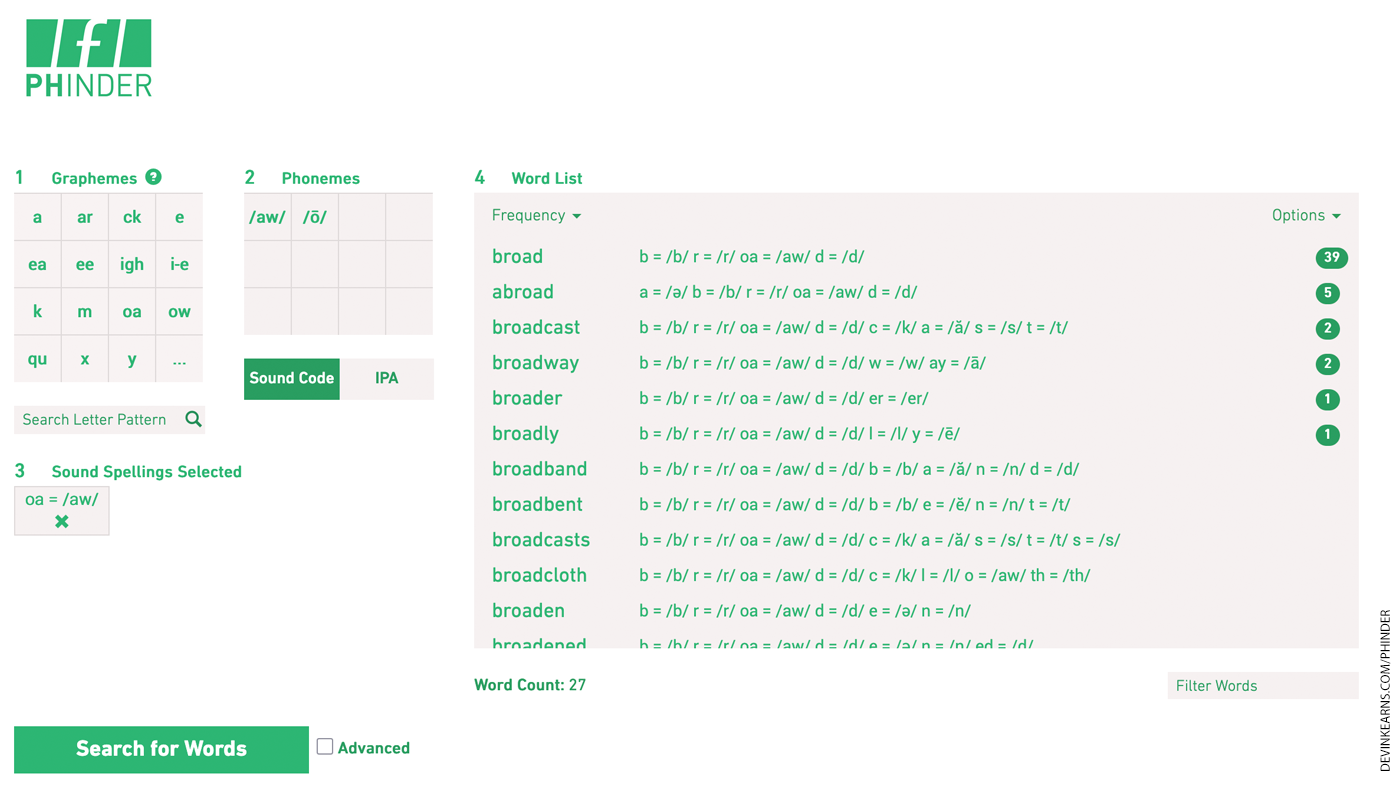
Kearns, on the other hand, has developed a free tool called Phinder to help teachers find words for each letter pattern they’re teaching—and as a secondary benefit, it can determine the ROI on teaching certain patterns.
Users select a letter pattern and sound they want to teach. For example, you might choose the oa pattern, which can say the long /ō/ sound, as in road, or the /aw/ sound, as in broad. The database offers a list of words and indicates how many times each word appears per million words (in a database of common words).
Within a list of words in which oa says the long /ō/ sound, you’ll see that road is the most common word, and it shows up 269 times per million. For words in which the oa pattern says /aw/, the most common word is broad, and it appears just 39 times.
A teacher might conclude that teaching a separate lesson on oa as /aw/ just might not be worth the effort.
Hot-Button Issues: Phonemic Awareness and Syllable Division
Among the most inflammatory topics right now in reading instruction is whether—and how much—to teach phonemic awareness.
Phonemic awareness is the ability to identify and manipulate the individual sounds in spoken words—for example, knowing that ship is made up of the three sounds /sh/, /i/, and /p/. Having good phonemic awareness has long been understood as a requirement for successful reading.
And while there’s evidence that basic phonemic awareness skills have positive effects for reading, the nuances matter. Studies show phonemic awareness should be developed by using written letters—not orally, which is how most classrooms and curricula do this instruction. And the idea that practicing advanced phonemic awareness skills like adding, deleting, and substituting sounds orally is beneficial for readers—asking students, for instance, to switch the middle sound in ship to the short /o/ sound to make shop? That’s not backed by science at all.
“I know of no researchers who advocated what people have been doing, which is teaching the phonemes in isolation as elements of speech,” says Seidenberg. “You can skip that whole thing. You just go straight into phonics, and the kid will learn about the phonemes as they’re learning about sound-spelling correspondences.”
Further, a recent study on the popular Heggerty phonemic awareness program found it had no benefits for students’ word reading or reading fluency.
“The idea that you need to have separate dedicated time blocks focused on only phonemic awareness instruction is not evidence-based,” says Clemens.
Another instructional practice that has recently supplied fodder for debate is what’s called syllable division—the teaching of rules for dividing multisyllabic words into manageable chunks. Syllable division rules are a mainstay of the Orton-Gillingham method for teaching reading, which was developed in the 1930s. Programs based on this method tend to teach six or so syllable types along with a half-dozen rules for dividing syllables. Some methods go further and have students mark up the multisyllabic word, identifying the vowels and consonants and labeling each syllable type.
Research by Kearns has some people questioning the efficacy of teaching syllable division. His 2020 study found that syllable pronunciations are unreliable, so the effort involved in learning these rules may not be justified.
Tiffany Peltier, the director of professional learning at NWEA, a K–12 assessment and research nonprofit, points to “really rigid syllable division rules” as among the more frustrating instructional routines to encounter. “People are trying to teach these to the most struggling readers who already have cognitive overload,” she says.
Instead of rigid rules, researchers including Kearns emphasize teaching students to be flexible in how they pronounce words—a concept known as “set for variability.” For example, a student might initially read the word father as fay-ther, which is a reasonable pronunciation, and then shift the vowel sounds slightly until getting to a familiar word. The student is not guessing (a practice promoted by now disgraced balanced literacy approaches). Rather, the student is using their phonics knowledge to sound out the word but being flexible with their pronunciation and calling upon their knowledge of the word father.
Teacher Excitement About How Language Works
Another reason teachers relay too much information: sheer enthusiasm. When teachers start digging into how the English language works, they want to share that knowledge with students—explaining why, for instance, ck appears in the middle of the words bucket and pocket but not the word picnic.
“I spent my career studying language; there’s a lot of cool things about it,” says Seidenberg. But often teacher-training programs don’t “draw distinction between learning about how the system works and deciding what’s essential to actually teach the child.”
Over-teaching also occurs with the terminology related to language. Training programs tend to hammer on the jargon of reading instruction, much of which is new to teachers, who end up passing their fresh knowledge along to their charges. Students can become bombarded by terms like breve and macron, fricative and affricate.
“Do [students] really need to be able to say what a diphthong is?” says Spear-Swerling. “They need to be able to look at the letter pattern and say the sound. They need to be able to, when they see o-i, know it says oy. That’s it. They don’t need to be able to give a definition.”

More Phonics Means Less Time for Reading
The researchers I spoke with agreed that the focus on process during phonics instruction has happened to the detriment of one skill above all: actual reading.
“Everyone knows that real, actual reading is getting squeezed out because there’s so much attention to the components,” says Seidenberg.
Reading in context generally comes at the end of a phonics lesson, and with so much to cover, teachers can end up with just a few minutes for it. At times, they’ll skip it altogether.
But text reading is where decoding and language skills meet—it’s why teachers and students are doing this dance at all.
“Reading connected text allows students to read words in meaningful sentences and paragraphs, allows them to practice to build fluency, and gives [them] the context for understanding, for making inferences, for connecting to prior experiences and background knowledge, to continue building background knowledge, to talk about the vocabulary that’s occurring in the text,” says Clemens.
It’s well documented that students with more background knowledge and better vocabularies are better readers (see “Rediscovering Knowledge as the Key to Reading,” features, Vol. 26 No. 1). Advocates for the science of reading recognize that decoding is only part of the battle and have pushed for knowledge-rich curricula as a component of research-backed instruction. Reading books and other texts provides a way to learn about words and the world.
So, what does this all really mean for busy teachers? One major benefit of whittling down instruction to the most essential skills is that there’s less material for teachers to get through. When teachers remove low-payoff patterns, skip the cutesy extras, and refrain from imparting technical knowledge, they make their own jobs more manageable—and get kids reading faster.
EdNext in your inbox
Sign up for the EdNext Weekly newsletter, and stay up to date with the Daily Digest, delivered straight to your inbox.
Avoiding over-teaching also means speeding through skills students already know, which requires frequent assessment and a good understanding of what’s coming next in the scope and sequence. Teachers get better at this with time and experience. The goal is not doing the perfect amount of explicit instruction—the science doesn’t prescribe a “perfect” amount. Instead, the aim is to move toward a more efficient path for a teacher’s particular classroom. The minutes saved here and there add up.
In a recent Education Week article, Mike Schmoker, a former teacher and administrator, and Timothy Shanahan, a distinguished professor emeritus at the University of Illinois at Chicago, argue that explicit phonics instruction should happen mainly in a whole-group setting to ensure all students get a high dosage of good teaching.
That notion is not necessarily in conflict with reducing over-teaching. If whole-group direct instruction happens daily but is limited to the most impactful skills—and kept short and simple—then students can move into small groups to either keep practicing, expand on the skill, or work on text reading or writing. In effect, they get to individualized instruction faster.
Peltier explains that, when she was teaching kindergarten and 1st grade, she would do a whole-class review of a prior phonics skill and then send her fluent readers off to “book clubs,” where they would read independently and have discussions. She would work with the remaining two-thirds or so of her class on that day’s phonics skill. “I’d usually at some point release another group of students and have the lowest students in front of me,” she says. “They loved it because they’d get to do more practice with the teacher on dry erase boards.”
That kind of gradual-release model helps ensure the highfliers spend time reading, and the students who need the most practice and feedback get more instruction from the teacher. And you can assess those kids in the moment—see who is getting the skill and ready to move on and who isn’t.
Research from the late Carol Connor, who was an education professor at the University of California, Irvine, points to the need to adjust the amount of teacher-directed instruction based on a child’s literacy skills. She found that 1st graders who entered with low skills did best with more time spent doing teacher-managed explicit instruction. For students with high initial skills, their scores stayed stagnant no matter how much time they spent learning directly from the teacher. And, in fact, students with both high decoding and vocabulary skills showed better growth with more independent work. For those high achievers who “don’t need a lot of repetition, that self-teaching machine will start a lot earlier,” says Peltier.
Dialing Back, but Not Reversing Course
To argue that schools are over-teaching phonics is to risk being seen as a naysayer—someone who believes the tide will inevitably and rightfully turn back to more “balanced” practices that de-emphasize using systems for teaching phonics.
I’ve spent much of my career as an educator and journalist standing up for science-based instruction, and that has nothing to do with what I think will or should happen. Not a single researcher I spoke with questioned the need for explicit teaching on how the code works. Where they questioned current practices—and disagreed with each other—was on the exact skills and dosage for instruction.
“I’ve been trying to calibrate how much is enough. And the answer is, you want to do enough explicit instruction to enable them to achieve this sort of breakthrough,” says Seidenberg. “The amount of explicit instruction you need is to get to the point where they don’t need so much explicit instruction.”
For typically developing students, Seidenberg argues, explicit phonics instruction should end after 1st grade. That’s out of step with much of the recent state legislation that is focused on K–3 classrooms and with the widely available programs that teach advanced word-recognition skills through the 5th grade. It’s also an assertion that will elicit eye rolls from teachers working through the challenges of having 25 students from diverse backgrounds and language contexts.
But the need to trim the fat on instruction—to focus on a skill’s ROI and churn out readers faster—is something many can agree on. It requires ongoing scrutiny of practices claiming to be aligned to research, frequent assessment of what individual students know, and a willingness to trust that, in many situations and for most students, learning begets learning.
“I think that the science-of-reading movement can win if we’re scientific, if we’re willing to challenge our assumptions,” says Kearns. That means continuing to look at the evidence on long-held instructional beliefs, such as those around syllable division, and changing course as new evidence arises. “If we’re willing to go there, science can win. If we’re going to stick to our guns, it won’t work.”

Liana Loewus is an education journalist and editor who has worked at Education Week, U.S. News & World Report, and WETA. She began her career as a special education teacher and reading specialist trained in research-based instruction.
Suggested citation format:
Loewus, L. (2026). “The Cost of Over-Teaching Phonics: In teaching reading, don’t miss the forest for the trees.” Education Next, 26(2), 7 April 2026.