


At last week’s ASU-GSV conference in San Diego, I was asked to try to decipher the state of education politics alongside my friends Andy Rotherham and Penny Schwinn. Penny moderated, asking great questions. The responses to our conversation I’ve gotten since make me think it’s worth revisiting some of what we touched upon. In the spirit of the initial confab, let’s hit some of the key points Q&A-style.
Q: Why is education so political today?
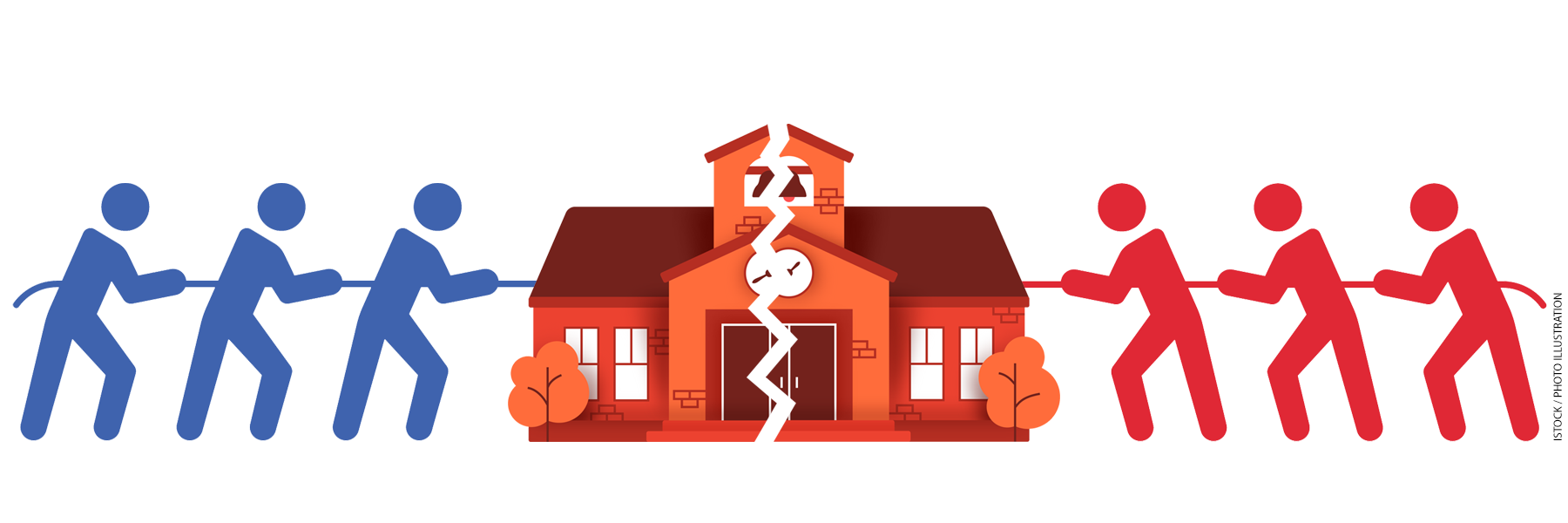
A: Education has always been political. But at least two big things have changed since the education reform fights of the 1980s and 1990s. First, the federal government has assumed a larger and larger role in K–12 and higher education over the past 25 years. This makes the fights more national in scope and means the party that controls the White House has more ways to jam its agenda forward. Second, intense polarization and the rise of social media have combined to reward activities that play to the base supporters, which gives a leg up to pols who are more intent on stoking outrage than on crafting reasonable compromises.
Q: Is it possible for education to be separated from politics?
A: Not really. The American public spends close to $2 trillion a year on K–12 and higher education. When public officials are allocating vast sums to provide a service through government-run or -subsidized institutions, there are going to be disagreements. Politics is how we resolve those without throwing rocks at one another. Education is inherently political. The question is whether our education politics are healthy or unhealthy.
Q: So, are our education politics healthy?
A: Nah, not really. I just mentioned the problem with social media, polarization, and the resulting incentives. More broadly, politics has been totalized. Politicians are supposed to be political, of course. But politics should be one thread in the broader civic tapestry. The problem is that political identity has taken on outsized importance in American life. During the pandemic, school closures became a test of one’s feelings about Donald Trump. Sensible attempts to revamp history standards or strengthen civics got co-opted by the progressive “America sucks” crowd, which has yielded a backlash from MAGA warriors. Much of today’s education politics isn’t even about ideology—it’s about theater.
Q: What do you mean it’s not about ideology? It seems like we’ve got intense ideological fights about education.
A: You’d think so, but you’d be surprised. Take gender identity or DEI, where it seems like there’s been intense polarization over the role schools play. When you look more closely, though, it turns out that 70 or 80 percent of the public tends to have settled on a sensible middle ground. A supermajority of the public wants policies that protect transgender youth from being harassed but doesn’t want biological males playing on girls’ sports teams. As for DEI, there’s broad support for “warts and all” history and promoting tolerance but little appetite for race-based preferences or for labeling the written word as a legacy of “white supremacy culture.” These are hugely reasonable positions.
Q: If there’s so much consensus, why does the discourse feel so angry?
A: The attention economy has created a thriving industry of outrage artists. While we’ve always had cranks, their reach used to be more limited. In 1996, the shysters were dependent on op-eds, newsletters, local talk radio stations, or the occasional cable news spot. Technological advances and new media have massively amplified their reach and impact. Today, 10 or 20 percent of the nation revels in outrage chic, with a cottage industry of shitposters, TikTok influencers, podcasters, meme lords, activists, and cable personalities monetizing the culture war by packaging it as soundtracked, video-saturated entertainment. There’s money, status, and advancement for the most incendiary. What looks like deep-seated political conflict is mostly just provocation theater. It’s kayfabe, but instead of a wrestling ring, it’s everywhere.
Q: Does this mean that education is always going to be held captive by these provocateurs?
A: Nah, not necessarily. As the fights over DEI or locker rooms recede, it’s easier to see that voters are much less polarized on education than are the party activists. School choice is broadly popular with voters left and right, as are expanding career pathways or ending race-based admissions preferences. Both left and right think that college costs too much and that abolishing the federal Department of Education is a bad idea.
Q: What would a healthier education politics look like going forward?
A: It wouldn’t be about kumbaya. Politics is supposed to be how we tackle principled disagreements. I’ve long said it was a problem that right-leaning reformers and public officials failed to defend core principles during the Bush-Obama school reform era or when the woke tide swept over us during Trump 1.0. The failure of normie leaders to do so helped make the hucksters and outrage artists look like courageous truth-tellers. A healthier politics isn’t about playing pattycake. It’s about focusing on substance rather than social media, outcomes rather than outrage, and the quiet 80 percent rather than the obnoxious 20 percent.
Q: How do we get from here to there?
A: That’s the question, all right.
Subscribe to Old School with Rick Hess
Get the latest from Rick, delivered straight to your inbox.
Q: Are there any places where you see this sort of leadership?
A: In deep-red and deep-blue states, public officials have more incentive to play to the activist base. But in more mixed environments, you’ve seen Jared Polis embrace the Federal Scholarship Tax Credit in Colorado and Virginia’s Glenn Youngkin champion higher standards. Those are examples of pols making principled arguments pitched to the 80 percent.
Q: You didn’t mention the science of reading, which has been a pretty significant political accomplishment. Why not?
A: This one’s tricky because “science of reading” means different things in different places. Leaders in every state are on board if it means, “Let’s improve reading instruction.” But doing it well entails heavy lifting: more emphasis on testing, holding students back, overhauling teacher preparation, and requiring teachers to change practice. That means picking fights with influential constituencies, and a lot of public officials would rather mouth the words than pick those fights.
Q: So, it’s too early to say if the momentum behind the science of reading is as big a win as we hope?
A: Yup. Far too early.
Q: What’s that mean for other popular proposals, like phone bans or career and technical education?
A: There are a lot of parallels with reading. Phone bans and CTE have momentum. They’re broadly appealing and don’t trigger performative blowback from either base. But we’ve seen that phone bans are hard to do well and that a lot of CTE is more sizzle than steak. So, the real test isn’t adopting an initiative; it’s how coherent it is and how well you follow through with it. That’s where patient, serious political leadership makes a big difference.
Q: Any final words of advice for navigating education politics in 2026?
A: Keep politics in its place. Talk to people from outside your bubble. And don’t assume that the bleatings of the 20 percent reflect the views of the 80 percent.
Frederick Hess is an executive editor of Education Next and the author of the blog “Old School with Rick Hess.”