




For decades, reading instruction in the United States has focused on helping children acquire generic, transferable skills such as finding the main idea of a passage or drawing inferences. At the same time, educators have minimized the contribution that knowledge makes to reading—the idea that knowing something about the topic of a passage helps a reader make sense of it. Advocates for the skills-based approach have argued that children clearly needed to learn skills, but they didn’t have to store much knowledge in memory; they could always look it up, especially in the digital age. Contending that children need to learn some facts made one seem a nostalgic fuddy-duddy.
But something has changed, and knowledge is having a moment in education fashion. All of today’s best-selling reading curricula describe themselves as “knowledge-rich” or trumpet that they “build knowledge intentionally.” The authors of this article are tickled pink by this development—one of us has argued for the importance of knowledge to reading for 20 years, and the other for 40. But we use the phrase “moment in education fashion” advisedly, well knowing the faddish nature of education enthusiasms. Indeed, a cynic might wonder if some of today’s knowledge advocates will next week declare that knowledge is irrelevant to reading education, using some baseless logic such as the inevitability of brain computer-chip implants.
In hopes that we can help knowledge transition from fad to mainstay, we offer this article as a primer on how knowledge indispensably supports reading comprehension and critical thinking. Our case rests on three main pillars. First, we will review the empirical evidence for the importance of knowledge to comprehension. Second, in the interests of avoiding past mistakes, we will examine the faulty assumptions that hampered reading instruction for nearly a century. Third, we will look to the future and offer what we believe are reasonable predictions for improved student outcomes and even restored national comity if districts stick with knowledge-rich, carefully sequenced curricula.
Evidence That Knowledge Supports Reading Comprehension
To understand how knowledge contributes to comprehension, we can look at the very structure of language itself and how a reader uses that structure when reading. Obviously, one must know the meaning of individual words to understand a text. Consider this example, from a text about plastics in the ocean, which has appeared on the National Assessment of Educational Progress (NAEP) for 8th graders: “The liquid in the jug resembles a gutter puddle in Manhattan more than the placid blue of the Pacific.” Readers must know the word “placid” and the reference to “Manhattan” to understand the sentence.
But even if readers do know all the vocabulary words, content knowledge contributes to their understanding of whole sentences. Normally, we think grammar supports that meaning: The difference between “Don slapped Dan on the back” and “Dan slapped Don on the back” lies in the sequencing of the words and how we apply the rules of grammar to interpret that difference. But there can be more than one way to apply grammar rules to a sentence, yielding more than one interpretation.
Consider this passage from the NAEP 4th-grade reading test. “My goodness, the rope is wearing out. It must be due to the sun and the rain for, as you know, it has not been used much. We shall have to get a new one.” The final sentence is ambiguous because the grammar doesn’t tell the reader whether “one” is a noun (referring to the lowest cardinal number) or a pronoun (referring to something or someone previously mentioned). If it’s a pronoun, it’s still indeterminate—the reader must deduce the antecedent of “one.”
Content knowledge resolves the ambiguity. A reader would know it doesn’t make sense to talk about a new numeral, nor a new sun; “one” must refer to the rope. This resolution of the ambiguity may not seem so marvelous because it’s so obvious. But that’s the point. A reader’s knowledge of the world—the nature of numerals, suns, and ropes—is brought to bear on the sentence outside of awareness. The reader doesn’t think about the various interpretations of “one” and reason about which must be right. This unconscious process happens so rapidly and seamlessly the reader doesn’t notice the aid to comprehension.

Content knowledge contributes to comprehension in another way—it helps the reader bridge the meaning between sentences. Another passage on the NAEP for 4th graders tells the story of a mouse with an artistic bent who can’t focus his mind on typical mouse business like scurrying. One passage describes him “staring at the light pouring in through the stained glass windows of the castle. He stood on his hind legs and held his handkerchief over his heart.” The reader is meant to understand a causal connection here. The mouse holds the handkerchief over his heart because he’s moved by the sight of the stained glass. But the passage never states that light pouring through stained glass is beautiful, nor that holding a handkerchief over one’s heart is the kind of thing one might do when moved by beauty. The reader is expected to know these things. If she does, she’ll fully understand the passage via the unconscious application of this knowledge. But if the reader lacks this knowledge, she may understand the actions described—staring at the light, holding the handkerchief—but miss their connection and thus their significance.
We can see that for this purpose the writer and reader must have shared knowledge. The writer need not spell out shared knowledge and can omit it. Imagine how tedious prose would be if every writer assumed you knew nothing and thus felt compelled to explain everything. Instead of “Maya pulled out her umbrella,” you’d read a long disquisition on the function of umbrellas, on how people don’t like getting wet when fully clothed, and so on.
The way shared knowledge supports effective, efficient communication highlights two important properties of this knowledge. First, it is culture-bound. Readers and writers within a culture share more factual knowledge than those across cultures. People within a culture share more knowledge because they have similar experiences, interpret these experiences in more similar ways, and share similar values. An author born and raised in the United States would be unsure of how to write for a Cameroonian audience because so many areas of his knowledge would not overlap with his readers’. The injunction to writers to “know your audience” really means “think about what your audience knows.”
Second, the knowledge that facilitates communication within a culture will change over time. Some of what Americans “know” today will later prove inaccurate or unimportant. Culture evolves, and the knowledge of a culture evolves with it.
The foregoing analysis is suggestive, but do we actually see an impact of knowledge on the kind of reading children do at school? Researchers have examined this question in four ways, all of which show that content knowledge makes a strong contribution to comprehension.
The first way is through expertise studies. Researchers compare readers with comparable general reading performance (as measured by standard reading tests), or they statistically control for this measure. But the researchers separate the children (or adults) they are studying based on their expertise in some subject. In one often-cited study, the subject was baseball. Other studies have compared readers who varied in their knowledge of football, soccer, food chains, spiders, cardiology, or photocopy technology.
These studies show that readers who know something about the topic of a passage understand it better than readers who don’t, even though their general reading performance predicts they should not. People often interpret reading tests as measuring an abstract skill—reading—that can be applied to any text equally well. These studies show that content knowledge influences comprehension of a passage—including passages on a reading test. What, then, do reading tests actually test?
That question inspired the second source of evidence. Perhaps people who score well on reading tests are those with very broad knowledge: Whatever passage appears on the test, these readers will likely know something about its topic. That prediction turns out to be true. Among high school students, the differences in performance on a reading test are largely due to knowledge. In one experiment, even after statistically controlling for IQ, the correlation between reading test scores and scores on a battery of broad knowledge tests was quite high (r=0.68).
The third type of evidence examines the straightforward prediction that if children gain knowledge about a topic, they will read passages about that topic more successfully. In one example, researchers provided thematic lessons in science and social studies in 1st grade. The researchers supported reading of related books over the summer and continued with extended science instruction in 2nd grade. The goal was not only to teach children specific content, but also “big ideas” in a domain. For example, researchers chose readings to help children understand how scientists understand events that happened in the past, such as dinosaur extinctions.
Compared to peers receiving typical reading instruction, students in the intervention experienced smaller summer declines in general reading performance and later outperformed control-group students on science reading comprehension, particularly when texts contained concepts or vocabulary aligned with prior instruction. These gains did not extend to all measures of vocabulary depth, but the findings suggest that coordinated, thematically linked instruction across grades builds domain knowledge and improves students’ ability to transfer that knowledge to new reading tasks.
The final type of evidence examines the effect of a multi-year curriculum designed to build knowledge that will support reading. One study followed children who won or lost kindergarten lotteries to attend Core Knowledge charter schools in Colorado (see “How Building Knowledge Boosts Literacy and Learning,” research, Spring 2024). The schools did not use a set curriculum but followed a detailed, grade-by-grade sequence of topics. By comparing lottery winners to non-winners, the researchers found that students who attended Core Knowledge schools scored much higher on state reading tests in grades 3 through 6 and demonstrated gains in science and smaller improvements in math. The gain in reading amounted to about 16 percentile points.
This study is notable because it tested the effect of knowledge building for up to seven years, much longer than most studies, and it gauged the outcome using state tests rather than a measure designed by the experimenter and yoked to the intervention. While we caution against relying too heavily on the results of a single study, the effects observed here were far larger and more lasting than those seen in most reading interventions, which tend to fade quickly. And these findings square well with the results of other studies examining the role of knowledge in curricula.
In sum, we’ve described four types of evidence supporting the idea that content knowledge is a critical contributor to reading comprehension. The fact that there are four different types of evidence has special importance. Researchers value what they call “converging methods”—using different research strategies to address the same question—because every type of study has its flaws. But different methods have different flaws, so if they all point to the same conclusion, we can be more confident that the conclusion is not an artifact of the research design.

What Took So Long?
This confidence invites another question: If there’s so much evidence for the importance of knowledge, what took so long? Researchers began to appreciate the crucial relationship between shared knowledge and reading in the 1970s and 1980s. Why did it take decades for knowledge to get its due in curricula?
To answer these questions, we must consider what this new emphasis on knowledge has replaced. What did educators adopt as the guiding principle for the selection of reading content for students?
The answer is “each child’s reading level,” based on that child’s technical reading skill. That individualistic orientation gave rise to the now criticized leveled-reading approach, which aimed to advance general reading ability while still encouraging individualism and student choice.
The technical goal was for each child to read a text at just the right level of difficulty for him or her. Schools would use diagnostic assessments to assign each student a “level,” often represented by letters, numbers, or color codes. Educators organized classroom libraries around these levels, and students were assigned or could choose books within their designated range. Teachers used small-group instruction to work with students at similar levels, adjusting materials and prompts as their skills developed. The hope was that, in a classroom where children varied in reading progress, everyone would read books they could comprehend, and everyone would make steady progress.
Of course, the research presented earlier poses a significant challenge to this instructional plan: How can you assign a “reading level” to a student when comprehension depends not only on technical skill but also on the student’s knowledge of a passage’s topic? Given that few reading researchers were focused on the role of relevant background knowledge, it’s not surprising that this problem was not raised in the professional literature.
But some researchers did sound the alarm on other problems in the use of levels. Some noted that leveled-reading instruction often meant that children were paired with texts they could easily read—and asked how their reading could improve if they were not challenged. Other researchers pointed to a lack of reliability in the assessment of a text’s level of difficulty. Most concerning was the limited evidence that differentiating by level (or not) actually made a difference to student progress.
Yet leveled reading persisted, for a number of reasons: institutional inertia, for example, and the seemingly obvious logic that children should read books that are neither too easy nor too difficult. We want to highlight another, underappreciated factor: deeply held societal beliefs about childhood that seemed to validate the concept of leveled reading.
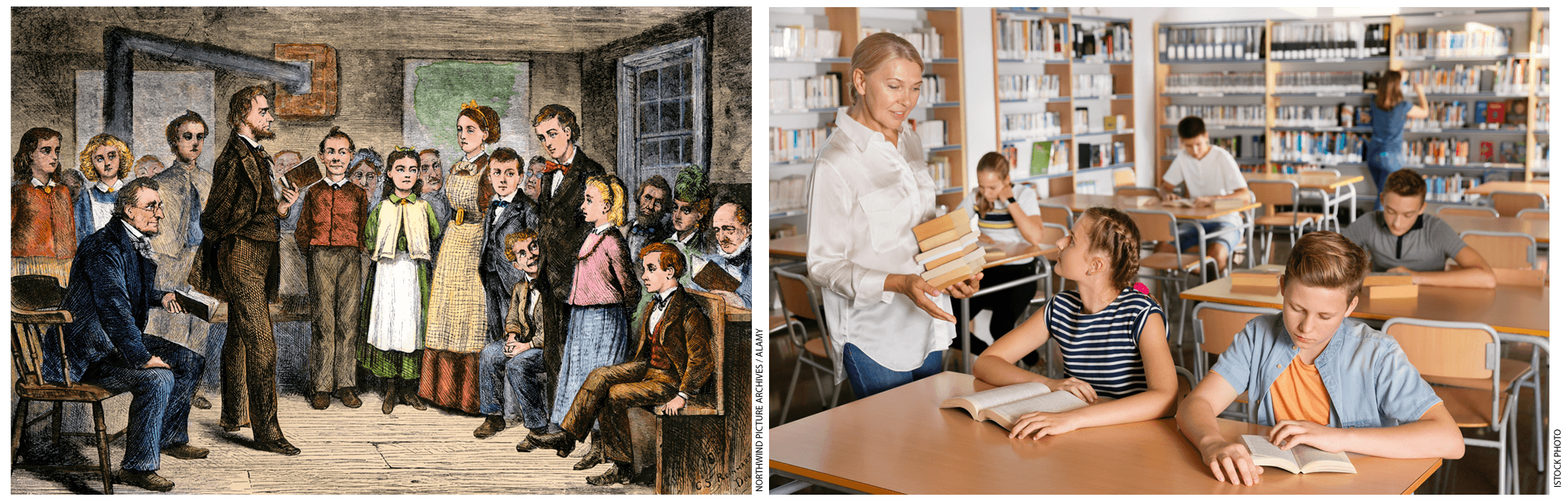
Historically, our shared understanding of the human condition has influenced the goals established for education and the schooling approaches designed to reach those goals. Prior to the mid-19th century, American education was heavily influenced by Puritan and Enlightenment worldviews, which held that humans are corruptible and that institutions like schools, churches, and governments existed to guide individuals to thoughts and behaviors more in line with God’s intentions and civic order. Prominent thinkers of the time believed that the purpose of schooling was to enable citizens to read the Bible themselves (John Winthrop, Cotton Mather); to engender practical self-sufficiency (Benjamin Franklin); or to fulfill civic duties (Thomas Jefferson, Noah Webster).
This view of humankind and the purpose of school shifted in the mid-19th century. In Europe, Romantic ideas developed in response to the Enlightenment (as seen, for example, in the writing of Jean-Jacques Rousseau, Johann Heinrich Pestalozzi, and Friedrich Froebel). These new ideas came to America first through transcendentalist thinkers such as Ralph Waldo Emerson and Bronson Alcott and later through philosophers of education such as William Torrey Harris and John Dewey, who brought a radically different sensibility to schooling.
Romanticism resisted organized religion, but in contrast to Enlightenment rationalism and its stress on civil institutions, the Romantics prized personal spirituality and trust in nature and instinct. Learning was seen as a process of growth from within, a natural unfolding, rather than instruction from without. The child’s instincts could be trusted because, as Wordsworth put it, “Nature never did betray the heart that loved her.” The implicit theology of the progressive, child-centered tradition of education held that inborn instincts and natural growth are inherently guided by God. The goal of education was to nurture the child to become what he was always meant to become and would only fail to become if adults interfered in the process. The teacher was a guide or nurturer of this progressive development, not an authority or disciplinarian.
These views need not form an explicit creed in order to shape society’s approach to schooling. As background assumptions, they can influence that approach and make certain truisms resonate. Today, we see the emphasis on individual experience in phrases like “personalized learning” and “teach the child, not the subject.” We view the belief in learning as a natural unfolding in suggestions that a teacher should act as “a guide at the side, not a sage on the stage,” and in warnings not to engage in teaching that is “developmentally inappropriate.”
And how might these background assumptions about the holy nature of children influence an educator’s view of reading? A belief in the primacy of meaningful experience and suspicion toward what’s gained by analytic methods fits well with a belief that children will learn to read by doing a lot of reading, and not necessarily by working through challenging texts that require instruction and help from the teacher. A belief that learning is a product of an individual growing at her own pace fits well with the practice of selecting books based on the child’s learning and growth, rather than selecting texts as a means of prompting that growth.
The Romantic sensibility sits well with another philosophy of reading instruction that survived years of counterevidence: whole language methods to teach decoding. These methods, which have only recently been widely discarded, emphasize meaningful experience (surrounding children with literature) and minimize methods that dissect experience (that is, phonics instruction). Whole language methods also assume that development largely unfolds naturally and that rich literary experiences will go far in helping children acquire the reading skills and habits they need.
Romanticism makes magnificent verse that should be studied as such. As an inspiration for education practices it has been ruinous. Enlightenment ideals of empiricism, reason, progress, and equality make, we think, much better guides and are consistent with a knowledge-rich curriculum.
Predictions
If a school switches from a curriculum that ignores the importance of knowledge building to one that prizes it, how will reading instruction advance? Plainly, we expect that students’ reading comprehension will improve. But we anticipate that educators and policymakers will have other questions related to this shift. Although further research is needed, we can draw some reasonable predictions from our current understanding of the role knowledge plays in reading:
How quickly will reading improve? If the goal is better performance on a standardized reading test (that is, one that is not tied to curriculum topics) we would not predict an immediate improvement—for example, at the end of one year of implementation. Our guess is that this progress will take three years or more. Here’s why: Shared content knowledge contributes to reading because writers omit information they assume the reader already knows. If we’re hoping to see improvement on state tests that were not written to align with a curriculum, educators can’t know which knowledge students need to acquire to do well on the tests. Hence, the goal we’re setting for knowledge building is really that students will know much of what is expected of a competent reader of their age in their culture. That’s great preparation for life after school, but it’s an ambitious goal. We expect that such broad knowledge accretes over years, not months.
We also suggest that knowledge building will improve oral language comprehension as well as reading. What’s more, it may well improve the learning of other subjects because shared background knowledge in the classroom enables the teacher to use an ever larger thesaurus of comprehensible analogies and metaphors understood by all children in the class.
Will a knowledge-rich curriculum solve all reading problems? No. Knowledge is a key driver of comprehension, but students still need to learn to decode fluently. And even students who make good progress in early grades sometimes face obstacles as texts become more complex. Some students who can decode short words have a particular problem with multisyllabic words. Other students stumble as syntax becomes more complex. And in high school, students learn that different disciplines have different conventions of communication. A scientist does not read and write the way a historian does, so more advanced students must master subject-specific reading goals and strategies. Content knowledge is necessary to being a competent general reader, but it is not sufficient on its own.
Are all knowledge-rich curricula equally good? Obviously, curricula vary in how well they engage students, how much support they provide to instructors, and so on. But is there anything about the knowledge component that might differentiate curricula? The answer lies in the importance of sequencing.
Because shared content knowledge supports comprehension, we can imagine the ideal text to give a student. Again, writers assume their readers have certain knowledge, and if the reader lacks it, she will have poor comprehension and may well give up out of frustration. Thus, the student will ideally know most of what’s needed to understand a text; with some effort and teacher support, she can work out the rest.
EdNext in your inbox
Sign up for the EdNext Weekly newsletter, and stay up to date with the Daily Digest, delivered straight to your inbox.
Hence, to provide the student with the ideal text, the teacher must have awareness of what the student already knows. That means that knowledge must be taught in a sequence, where knowledge builds slowly and systematically. It’s obvious that math content has prerequisite skills, and therefore, it’s crucial that math topics occur in the right sequence. It’s equally true, though less obvious, that knowledge builds on knowledge when it comes to reading. A curriculum should be not only knowledge rich, but also carefully sequenced. The knowledge required to read each new text should be made available to students through prior lessons and within the assignment itself. All students thus enabled are potential lively participants in the discussion of each new text.
How will this curriculum affect disadvantaged students? We have heard (many times) that a knowledge-rich curriculum might work well for children of wealthy parents but not for children growing up in need; they don’t have the support at home to master the content. We predict the opposite, that a knowledge-rich curriculum will bring an outsized advantage to children experiencing poverty.
Here’s the logic: Children growing up in wealthier homes have more opportunities to learn about the world. They have better access to books, educational toys, trips, and so on. And indeed, data show that as early as kindergarten entry, children from wealthier homes have more knowledge about the world than children experiencing poverty. Thus, for children from low-income homes, school may be the best source of content knowledge. When this source of knowledge becomes richer, it has an even greater effect.
The long-term study of a knowledge-rich curriculum cited above included one school that served many students living in poverty, and this school saw an outsized positive effect on test scores. Still, it was just one school, with a small student population, so more research is needed.
We also make a related prediction: Adoption of a knowledge-rich curriculum by a district (or better, a state) will help address the problem of student mobility. Changing schools for a reason other than promotion (for example, going from elementary to middle school) is associated with reduced achievement, even when confounding factors (for instance, children might change schools because they are bullied) are controlled. It’s also known that children experiencing poverty change schools more often, due to the job and housing uncertainty their parents face.
Students likely struggle after a move because leaving friends, neighbors, and teachers disrupts their lives. But stepping into a different curriculum can also contribute to the problem; a teacher might expect students to have learned things the previous year that simply weren’t covered at the student’s old school. If all schools within a district or even a state used the same curriculum, at least part of the cost of moving would be meliorated.
Not to Decide Is to Decide
Romantic faith in the child’s holy natural instincts should not determine the selection of a school’s reading curriculum. That responsibility rests with adults.
But can adults come to an agreement on content? When we argue for the benefits of a knowledge-rich curriculum, the question “Whose knowledge?” is inevitably raised. Naturally, there is no quick answer to that question. It is a matter that requires adult discussion and debate, and we expect that the result won’t please anyone entirely.
Policymakers are glad to avoid such difficult choices. That’s why our 50 states have abandoned their obligation to institute serious grade-by-grade core topics—without which universal high literacy is not possible. Romanticism was not just an unfortunate chapter in our history; it’s an ongoing refuge for evasive political leaders. Parents and everyone else who cares about effective education should take note and demand that state legislators act on what scientists know about knowledge and reading.
Not making a choice about curriculum is still a choice. It is choosing haphazard content coverage and the resulting mediocre reading ability for our children. It is also choosing to tolerate appalling gaps between children who grow up in wealth and children who grow up in need.
The nation’s founders placed citizen literacy and the education that people need for intelligent self-government in the hands of the states to avoid ceding it to potential tyrants in the central government. Thomas Jefferson consistently stressed two themes when he wrote about instituting education in Virginia: the need for citizens to gain broad knowledge of history and, with that knowledge, to resist tyranny.
Opposing a common curriculum because it seems to privilege some knowledge over other knowledge is damming the trickle while neglecting the torrent. Our lack of a systematic, sequential, and shared curriculum induces low literacy and low wisdom. That poses a deep danger to civic competence and thus to democracy itself.

Daniel T. Willingham is a professor of psychology at the University of Virginia. His research focuses on the application of cognitive psychology to K–16 education. E. D. Hirsch Jr. is founder and chair of the Core Knowledge Foundation and professor emeritus of education and humanities at the University of Virginia.
Suggested citation format:
Willingham, D. T., and Hirsch Jr., E. D. (2026). “Rediscovering Knowledge as the Key to Reading: Two champions of knowledge-rich instruction reflect on its current momentum.” Education Next, 26(1), 24 March 2026.