

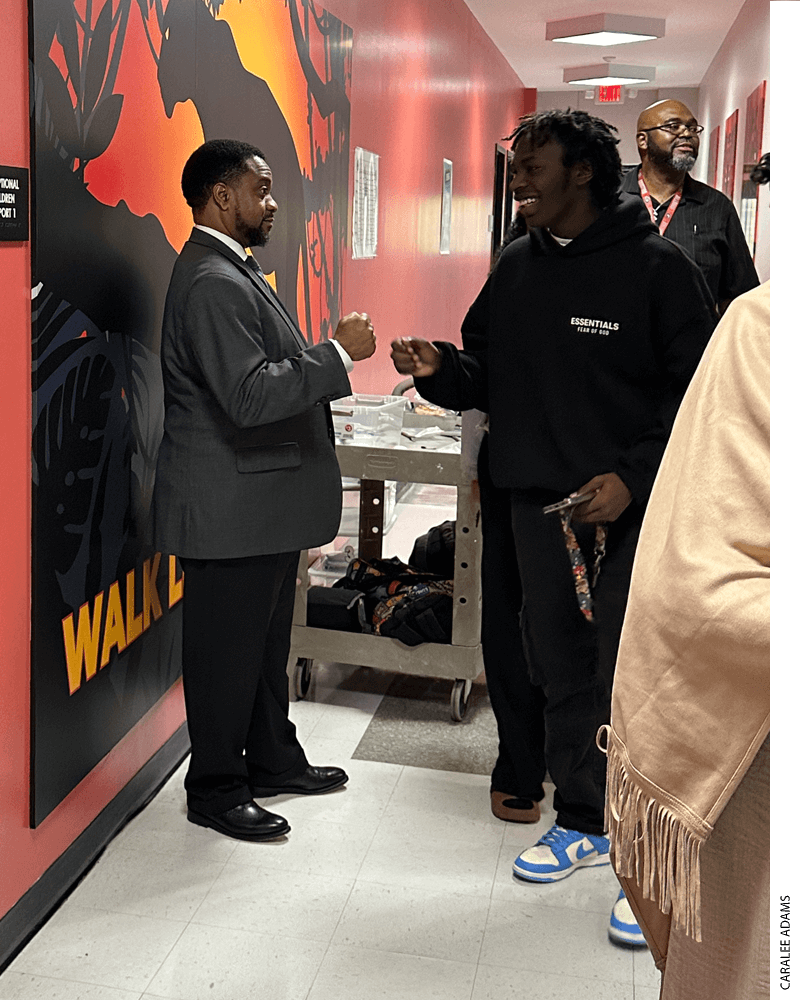
As students walk into Central Wake High School in Raleigh, North Carolina, they are greeted by multiple staff members. A teacher puts their phones in safe pouches for the day. Another places their belongings in a basket as they walk through the metal detector with a security guard and school resource officer nearby.
“Good morning, good morning!” says Executive Principal Thomas Hanley II with a smile, often addressing students by name. Salsa music is playing in the background on this September morning. Family support specialist Bria Coleman and one of her interns are on the lookout for any signs of distress.
“I try to identify any student that may come in upset and take them to our office to assess what’s going on, navigate, and help them calm down before going to class,” Coleman said.
When they leave four hours later, students are dismissed from one classroom at a time to avoid congestion and allow for that individual attention again. Students pick up their phones, and staff members line the hallway to say goodbye.
“I’m proud of you,” they say. “Be careful out there. . . . Make good decisions.” If a student arrived late that morning, a staff member takes them aside to find out why and encourage them to come on time the next day. The most common parting phrase, “See y’all tomorrow,” reinforces the expectation that they will indeed return and a promise from the staff that the students will be seen.
A Change of Scenery Designed to Respond to Student Needs
Central Wake is a small public charter school that provides a personalized approach to learning for students who have dropped out of high school or are on the verge of doing so. It is one of 27 schools run by Second Mile Education, a private for-profit company based in Orlando that operates in North Carolina, Florida, and Georgia, with plans to expand to South Carolina and Texas. The school’s condensed instructional day and self-paced curriculum appeals to students who haven’t been able to make it in a comprehensive high school.
Most students come to Central Wake because they are failing academically or missing too much school, Hanley said. Some have families that are transient or have caregiving responsibilities for siblings, parents, or their own children. And post-Covid, the school has seen an influx of teens dealing with anxiety or depression.
For all these reasons and more, these students are looking for a second chance and a new pathway to earn a high school diploma, said Hanley, who opened the school 10 years ago with 120 students. Today, 363 are enrolled.
“Oftentimes these students just need a change in environment. They need a change in the modality in which they learn,” Hanley said. “Sitting in a classroom, passing classes every 55 minutes for seven-and-a-half hours might not be the best for them.”
Central Wake is a Title I school where approximately 85 percent of students come from low-income families. With extra academic support and wraparound services, students begin to see a way forward. “We’re making what they thought was impossible possible,” Hanley said.
North Carolina policymakers have adopted an alternative accountability model that allows schools like Central Wake flexibility in demonstrating how its approach works. Each year school administrators set goals for growth in math and reading test scores, credit-earning rates, GPA improvements, and student satisfaction. Central Wake has consistently received “highly effective” ratings for its work to engage students who have become disconnected from school.
Just what states expect from public schools that serve at-risk students varies widely.
Forty-four states, plus the District of Columbia, have policies defining alternative education schools or programs, according to data collected by Momentum Strategy & Research, a nonprofit based in Colorado and cofounded by Jim Griffin and Jody Ernst. Twenty states, plus D.C., have policies that either direct districts to report out on program elements, number of students served, and the status of students upon leaving, or that create alternative-school accountability systems that parallel traditional systems but recognize the schools’ unique missions.
Flexibility on Timing for Completion but Not on Standards
Students arrive by car, bus, on foot, or ride-share service to Central Wake, located in an office park in South Raleigh. They can choose one of three sessions to attend: 7:30 to 11:30 a.m., noon to 4 p.m., or 3 to 7 p.m. If students can’t attend their chosen session on a given day, perhaps because of work obligations or a glitch with daycare, they can attend a different one. Those eager to get their diploma quickly sometimes attend multiple sessions per day.
“Flexibility is our secret sauce,” Hanley said, who added the third late-afternoon session in fall 2025 in response to student demand, and interest continues to increase. Instead of having to pass a course within a set timeframe, such as one semester, students at Central Wake can take longer or advance faster as they demonstrate proficiency. “We’re not flexible on the standard that it takes to master a course,” Hanley said. “But we’re flexible on the time that it would take to complete.” The school year generally begins during the second week of August and ends in late June.
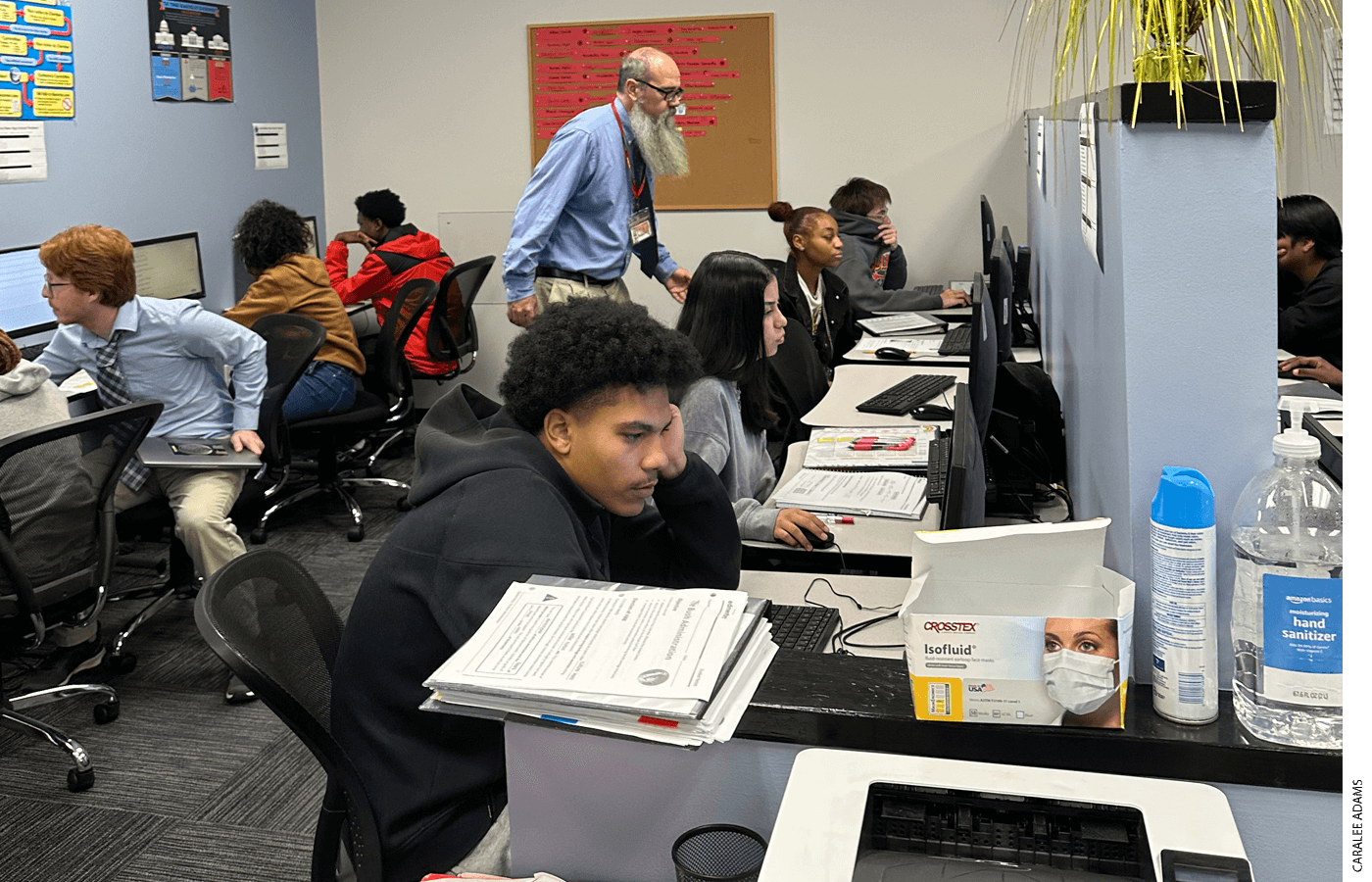
Students are assigned a classroom where they work independently at a computer workstation following an online curriculum by Edmentum. A dashboard pops up showing their progress toward the required 22 credits to graduate. A teacher staffs each classroom and has access to students’ accounts to see if they’re getting stuck and need help.
“I’m less a teacher to 25 and more of a tutor to 25 individuals,” said Robert Carr, a social studies teacher at Central Wake. As he walks through the classroom, he responds to students who raise their hands and asks others how they are doing. Some students work out problems with pencil and paper, so Carr often delivers worksheets off the printer.
When skill gaps are identified, a math, reading, or special education interventionist comes into the classroom or pulls out individual students for tutoring. The school uses blended learning and targeted small-group instruction to support students as they progress. Teachers analyze student data, help set learning targets, and monitor their work, Hanley said, while students take ownership of their learning and build confidence in their abilities.
Wesley Delaremore-Allen, 18, started at Central Wake in November 2024. He had attended a large nearby high school and said he had difficulty paying attention and making it to class regularly. At the charter school, Delaremore-Allen said he likes working at his own pace.
“It’s cool. It kind of feels like freedom,” said Delaremore-Allen, who has been attending school from 7:30 a.m. to 7 p.m.—all three daily sessions—in order to finish sooner and move on to college, where he wants to study marketing.
Jayden Stephens said he found it hard to focus on classes at his traditional high school, where fights broke out every day and essential structure was lacking. In March 2025 he entered Central Wake at the recommendation of his counselor, starting as a 10th grader. By the fall he had racked up enough credits to achieve senior status. “There are no distractions. It’s just you and the work,” said Stephens, who hopes to become a barber.
His mother, Lakia Stephens, said she was eager for him to change settings and improve his grades. “They set goals with them, and he’s had great connections with the teachers, who help in any way they can,” said Stephens. She also said she appreciated the parent orientation, which the school added in response to feedback from parents: “The communication is very welcome.”
Both Jayden Stephens and Wesley Delaremore-Allen are expected to graduate in March, Hanley said.
Individual Attention Ensures Students Are Seen and Supported
Students often come to Central Wake after they hear about it through their friends, family, or school counselors. They enter throughout the year and leave as they complete the program. How long that takes depends on how many credits students need to earn to graduate—and the intensity of their motivation. On average, students stay three semesters.
Students at high schools in the Second Mile network typically enroll two or more years behind in credits toward graduation. Many also enter significantly below grade level academically. Historically, students have averaged a 3rd-grade reading level and a 4th-grade math level.
Orientation at the Raleigh school starts with an uplifting video from last year’s graduation, followed by a slide presentation on the school’s rules and expectations by Mark Waller, orientation and attendance specialist. Among the slides: No phones allowed during the day. No hoods, beanies, or hats worn while on campus. Zero tolerance for fighting, drugs, or blatant disrespect. The school expects at least 85 percent attendance from every student, and staff follow up when students are absent—calling home, sending letters, scheduling parent meetings, conducting a home visit, if needed, and working with families to address underlying obstacles such as transportation or housing.
A student said he’s considering getting a new phone but worries that it might get lost or stolen. Waller assures him phones are locked up, and the school has security cameras. Another concern: What if someone hits him and he merely defends himself? Waller reiterates the no-fighting policy. Students can find that adjusting to the school’s strict rules presents a challenge, but some say it provides a sense of safety that allows them to concentrate.
After the overview, students take a brief academic assessment to get a snapshot of their skills coming into the program. They will continue to take the test every 90 days until they meet the required level for graduation. Those scores will be included in the data the school provides to its charter authorizer as evidence students are improving.
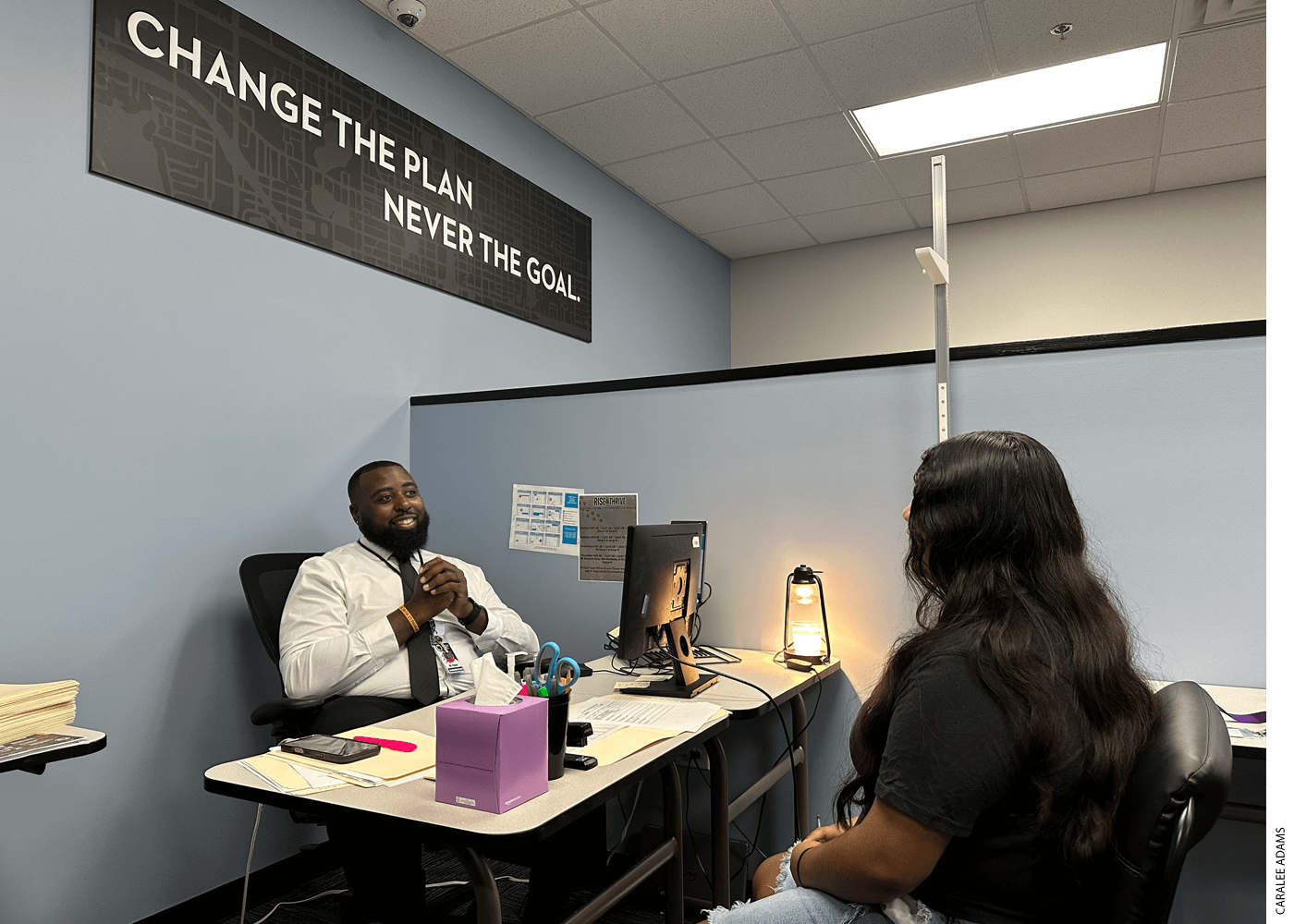
The school’s graduation coach, Javon Fluker, meets individually with students upon arrival to set goals for three, six, and nine months—and beyond. When one incoming student expresses an interest in day trading, where he’s heard a $10 investment can turn into $3,000 using AI, Fluker challenges his assumptions about making easy money. “In order to succeed at a lot of things, there’s a path,” Fluker said, encouraging the student to become a lifelong learner and first consider an internship or studying finance in college. Once a month, he meets with every student to track progress on their graduation goal and career plan.
“I tell students all the time, your pay is typically directly aligned to the quality of education that you have and the expertise that you have,” Fluker said.
Sha Campbell, a reading specialist, said her students are often so busy getting through the day that they haven’t given much thought to what they want to do after high school. In fall 2025 she began to ask a “question of the day” to get her students to imagine their options: “What personal qualities do I view as my strengths?” or “What would you do if you were guaranteed success?”
Campbell displays their answers, written on sticky notes, on the classroom walls. The exercise reminds her students that they are “determined, caring, and good writers,” with dreams to “be a baker, help kids who struggle with anger management, or start a business.” It also gives the school’s graduation and career coaches direction in creating programs that will match students’ interests.
“I’m trying to get them to realize that the things they love and care about are going to translate into a career,” Campbell said. As they talk with her about job opportunities, she said, it opens new doors and boosts their motivation.
Teachers at the school take a personal interest in the students, often becoming mentors and that all-important caring adult who keeps them engaged. “Our students have been kind of bumped and bruised and jaded, so it’s important they find their person,” Hanley said.
Brooke Defreese, a June 2025 graduate of Central Wake, said teachers would tell her, “You got this!” when she was feeling down. “This school does not let you give up. They want you to achieve your goals regardless,” said Defreese, who found the smaller setting eased her social anxiety. Two months later, on the day before she enrolled at a nearby community college to study forensic science, Defreese stopped by the high school to talk with her teachers. “I was so nervous,” she said. “They said they missed me—and I’m not going to lie, I miss them a lot too.” She may return to ask a teacher to read over one of her essays later in the semester. “That’s the kind of school they are,” Defreese said.
Hanley said he looks for teachers who know how to re-engage students who haven’t thrived in traditional settings. Many Central Wake teachers have experience working in alternative, credit-recovery, or at-risk settings. New hires complete an onboarding process that introduces them to the Second Mile model, its culture of belonging, and its instructional expectations. Teachers receive embedded job coaching, participate in monthly professional learning communities to share best practices, and can tap into the professional network that connects Second Mile’s 27 schools.
“At Central Wake, the curriculum matters, but the people make it work,” Hanley said. “The throughline is simple: clear goals, steady coaching, and a team that refuses to give up on kids.”
Knowing students and their stories helps teachers connect them with needed wraparound services. Coleman and her staff step in to help or to de-escalate tensions when they see a student who is crying or hear commotion in the hall. They offer crisis intervention and grief counseling, as well as wellness programs on managing healthy relationships and handling stress. The school has partnered with a food bank to provide groceries for families and healthy snacks for students during the day. Across the Second Mile network, company officials report 95 percent of students take advantage of the school’s family support services.
Developing Alternative Metrics to Show Growth
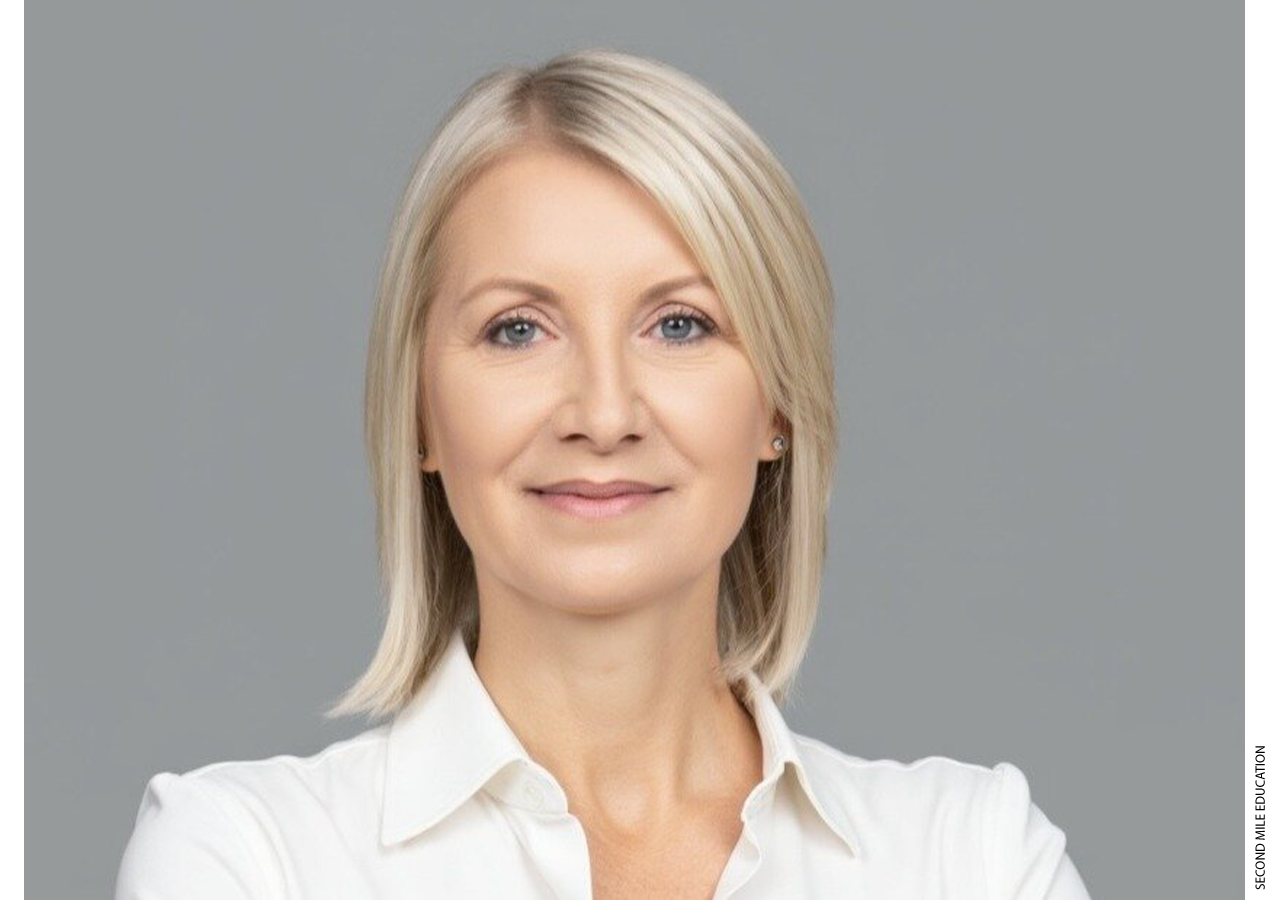
Education cannot be “one size fits all,” said Angela Whitford-Narine, chief executive officer of Second Mile Education, known as Accelerated Learning Solutions until February 2025. Describing the network’s campuses as “nontraditional” learning environments, she said the schools are designed to meet students where they are, with a customized approach. Because of the population they serve—highly mobile and often credit deficient—alternative schools maintain they also need a tailored approach to how they are evaluated, one that looks beyond traditional graduation rates.
“When you meet education leaders that are reasonable and recognize that even our accountability systems can’t be one-size-fits-all, then you can have some meaningful conversations around what defines quality in a school like this,” she said.
As states develop comprehensive testing and accountability systems with consequences for underperforming schools, alternative schools confront the need to propose alternative metrics, said Jim Griffin of Momentum Strategy & Research, which has tracked information on alternative schools, performance data, and state alternative accountability frameworks since 2013.
Griffin helped usher through one of the country’s first alternative accountability structures in 2002 when he was head of the Colorado League of Charter Schools. Alternative metrics are more prevalent in states that have schools (not just programs) for struggling students, and low performance has consequences, he said. It makes sense to look at outcomes differently in schools without a typical distribution of low- and-high performing students, he added, because alternative schools mostly serve those who are at the low end of the distribution.
“When you have uniformity of student performance types, your performance data is never going to fit within the accountability systems. They’re not written that way,” Griffin said. “These are exceptional schools, and they merit an exception to how the state does their measurement.”
In 2014, the North Carolina legislature passed a bill for a two-year pilot program for dropout prevention and credit recovery. That required the creation of an alternative accountability model.
“It was a really heavy lift to get that pilot program enacted,” said Laura DeVivo, a government relations consultant who worked for Second Mile to advocate for the flexible metrics and negotiate the details of the policy.
The legislation directed the state board of education to calculate each school’s enrollment (for funding purposes) in the fifth month after winter break rather than the first month of the academic year. This modification allowed schools serving at-risk students to count those who had enrolled midyear after failing or dropping out of their traditional schools.
North Carolina also started allowing charter schools to adopt the “alternative” designation, which previously had only been available to traditional schools. This move meant the state recognized that schools like Central Wake needed to be evaluated differently.
For accountability, North Carolina schools can now choose “Option C,” whereby schools design their own framework and goals. School leaders submit a plan to the state every year with goals based on their student population. “If the schools are succeeding at their mission, then they’re successful,” said DeVivo, noting however, the process is not easy, and results must pass the rigor of the accountability office.
The state’s regulatory framework allows schools, boards, and authorizers to measure progress in ways that reflect real student growth while remaining responsive to the changing needs of an at-risk student population, DeVivo said. “It’s a system designed for continuous improvement rather than static measurement,” she said.
Accountability and Monitoring in Practice
Alternative charter school plans in North Carolina must be approved first by the school’s local board and then by the state Department of Public Instruction (DPI) and Board of Education. Once a school establishes a model, the framework typically doesn’t change much, said Curtis Sonneman, acting director of the Office of Accountability at DPI. “It gets reviewed to see if there’s any substantive changes that we might want to discuss,” he said, “making sure that [its metrics] are valid and reliable measures of achievement and growth.”
Each year, schools submit information on students’ actual performance (such as exam scores and grades) along with their initial targets. Sonneman said that to ensure accuracy, DPI can request the underlying data behind the numbers. Because each school creates its own unique targets under Option C, the system does not lend itself to comparing one alternative school to another.
The alternative accountability system is tailored to alternative charters—unique schools that need a different kind of review that is “attainable and appropriate” for them, Sonneman said, whereas giving them an A–F grade might make them look low performing by virtue of the population they serve.
“At the end of the day, it’s a self-evaluation tool for them,” Sonneman said. “Over time, you will see that targets go up and down. . . . There’s a lot of variability in who’s coming and for what reasons. Letting [schools] set their targets and be self-reflective allows them to meet the needs of the kids that they’re serving.”
Central Wake’s state-approved plan has evolved from a credit-recovery focus that prioritized course completion to a more comprehensive framework with measures of academic knowledge, career technical education, and workplace skills, according to Hanley. In establishing its targets, the school reviews the previous year’s results, state DPI guidance for alternative settings, and research on engagement and recovery.
In 2024–25, Central Wake’s plan included seven approved measures: (1) achievement: percentage of students meeting grade-level standards on math or English state end-of-course exams; (2) reading growth: percentage of students attending one semester or longer who demonstrated growth on Reading Plus, an adaptive reading program that measures comprehension and fluency; (3) math growth: percentage showing growth on the GAIN assessment, a short-cycle diagnostic that measures math skills growth; (4) increased credit-earning rate: percentage of students who increase their rate of earning credits by at least one credit per semester compared to what they earned at their prior schools; (5) industry certification: percentage completing a career and technical education course and earning certification; (6) improved GPA: percentage improving GPA by at least 0.5 points; and (7) student satisfaction: percentage responding “agree” or “strongly agree” that the school provides a high-quality education.
For years, Central Wake has exceeded its targets in most categories. Feedback from student satisfaction surveys for the past three years shows 96 percent believe Central Wake is providing a high-quality education.
In 2024–25, however, the school fell short of its target in the measure for achievement, primarily because of math performance. The school has responded, administrators said, by strengthening instructional support with a dedicated math tutor and a math interventionist. When schools don’t meet their targets, the state does not impose a penalty, but the reports are made public, Sonneman said, and schools are accountable to parents, boards, and other stakeholders. Also, the state charter school review board collects and examines achievement data as part of its renewal process, providing another check in the system.
Whitford-Narine said that authorizers consistently renew Second Mile contracts for extended terms—citing the company’s transparency, compliance, and demonstrated student impact as evidence of quality.
Across the Second Mile network, the company reports 96 percent of schools earned the highest possible rating under their respective state alternative accountability frameworks in 2024–25. Students more than double their rate of credit earning after enrollment (from an average of 3.0 to 6.1 credits per year), and 86 percent improve at least one reading grade level within a single semester.
Policy Landscape for Alternative Schools
The policy landscape varies across the states where Second Mile operates. Florida has had alternative accountability metrics in place since the company opened its first school there in 2008.
Georgia does not have a statewide policy on alternative accountability, but for more than a decade Second Mile’s high school in Fulton County has had approval from the local charter school authorizer for flexible metrics to demonstrate its effectiveness. The school’s measurement standards include improved grade point average, rate of credit earning, and college preparedness, said Rob Fortson, a charter school attorney in Atlanta working with Second Mile.
A bipartisan bill proposed at the end of the 2025 Georgia legislative session would create a set of alternative metrics statewide. “We’re cautiously optimistic that it will be thoroughly vetted and hopefully move through the process in the beginning of 2026,” Fortson said.
Momentum Strategy & Research started documenting and sharing state-level policy action about a decade ago in an effort to shape better policy. “Until then, it was super isolated stuff,” Griffin said. “I don’t think anybody paid attention to it outside of their states and were just kind of winging it.”
No federal definition exists for “alternative” or “opportunity” schools, which amplifies the diverse policy landscape across states, said Greg Lippman, founder and chief executive officer of Groundswell Network, a nonprofit based in New York working to push a national conversation on best practices in this space. “It’s very difficult to identify and build confidence in particular approaches,” Lippman said, especially when expertise is siloed and policymakers don’t always have ready access to the data when making decisions.
For the model to work, school operators need time and partnerships, said Hanley, who has opened two Second Mile schools in Charlotte and one in Orlando.
“Without community, you can’t make this happen. You have to connect with people who have a similar vision and mission,” Hanley said. “We were not coming in to supplant the [existing] schools. We were coming in to support them and supplement them.”
Each Second Mile school is a public charter school governed by its own nonprofit board and accountable to its authorizer. The company, hired as a service provider to each school, acts as its management organization.
Revenue for schools in the network comes primarily from federal, state, and local funding, based on enrollment. Central Wake’s total per-pupil expenditure was $14,783 in 2024–25.
Whitford-Narine said the for-profit structure of Second Mile provides an advantage in getting new schools off the ground with start-up capital and early investment. Campuses can open with technology, training, and resources in place. The company manages finance, personnel, technology, procurement, and compliance at scale.
“Operating at the intersection of education, business operations, and community impact brings fresh perspectives and efficient solutions that many smaller nonprofits simply can’t achieve alone,” Whitford-Narine said. “The result is a partnership model that pairs nonprofit governance and public accountability with the capacity, expertise, and agility of a mission-driven, for-profit organization—all in service of students who deserve the best start possible.”
Aiming for Postsecondary Success
Beyond helping students earn a high school diploma, Central Wake works with them to develop an individual postsecondary plan that may include community college, university, military service, or the workforce.
In response to student-interest surveys, the school began offering career technical education courses in 2023–24 in culinary arts and hospitality, carpentry, construction safety, health science, and welding. In 2024–25 it started a dual-enrollment program with Wake Technical Community College to give students the option of getting industry-based certifications. In 2023–24, students earned 74 career and technical education (CTE) credits; in 2024–25, they earned 95 credits plus 24 certifications.
Central Wake added a CTE goal to its latest accountability cycle, aiming to have 50 percent of students in CTE courses earn industry certification. Thirty-seven percent did so—representing meaningful progress for a new initiative, Whitford-Narine maintained.
The high school created an advisory board with external partners from businesses and the community college that meets monthly to discuss strategies on how to reach and support students as they explore career pathways. Throughout the year, Central Wake invites representatives from colleges, businesses, and the military to make their pitch to students about career options.
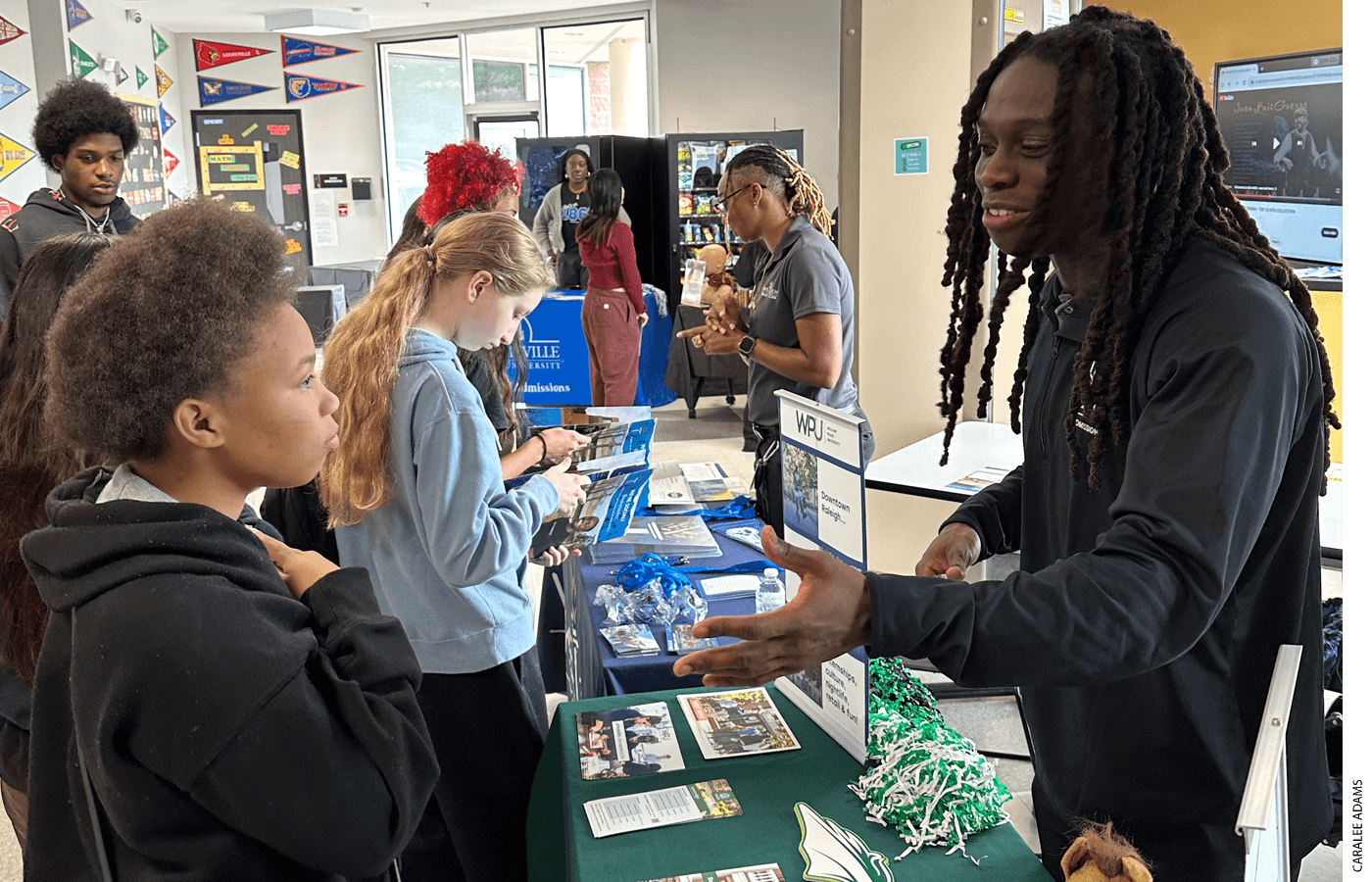
In early October 2025, Tamara Rogers, the school’s career coach, set up a college fair where students could ask questions of recruiters from nearby two-year community colleges, four-year state universities, and trade schools.
After Quenia Ruiz talked with a representative at nearby William Peace University, she was excited to learn that she might qualify for a scholarship to pursue her dream of becoming a middle school teacher. The 21-year-old is on track to graduate this year, after having dropped out of high school twice and attending Central Wake for two years.
EdNext in your inbox
Sign up for the EdNext Weekly newsletter, and stay up to date with the Daily Digest, delivered straight to your inbox.
Ruiz has a one-year-old son and, she said, the half-day schedule allowed her to attend school, get childcare, and work a restaurant job in the evenings. “The school is great for young moms and people who are working,” Ruiz said. “More schools should be like this one. It would decrease the number of dropouts.”
She’s among the roughly 40 percent of Central Wake students who are Hispanic.
Ruiz said she wants to break away from the pattern in her community where people don’t finish school and end up working a job in food service or construction instead of having a professional or technical career. “By the time I’m a teacher, [my son] will be in elementary school,” Ruiz said. “I don’t want my son to grow up and say, ‘Oh, my mom is just a cook.’ I want my son to be proud of me.”
Students at Central Wake are often the first in their families to go to college, so Rogers helps host information sessions on applying for financial aid and coordinates visits to college campuses. In spring 2025, when the school bussed a group of students to a college tour in Charlotte, many were able to apply, get accepted on the spot, and receive scholarship money.
“When they started speaking with the recruiters and got a chance to really have exposure to that environment, they were like, ‘Wait a minute. I do have something of value, and people do see something in me. Maybe college is a feasible thing,’” Hanley said.
For far too long, expectations for these students have been far too low, Hanley said. To get students to see future possibilities, he invites alumni to return to Central Wake and share their stories after graduating from college or landing a job.
In the 2024–25 school year, 81 percent of all Second Mile high school graduates indicated plans to pursue college or technical school, 2 percent planned to enlist in the military, and 17 percent intended to enter the workforce directly upon graduation. Follow-up surveys showed 68 percent have enrolled in a college or technical program, 7 percent have entered military service, and 20 percent have joined the workforce.
Celebrating and Looking Ahead
Every day before students leave Central Wake, announcements over the school’s public address system begin with an inspirational thought or new vocabulary word and end with this year’s slogan: “Rise and thrive!”
Sometimes, there’s an added bit of celebration. Throughout the year, each time a student graduates, “Pomp and Circumstance” is piped through the intercom. In 2024–25, the march was played 94 times. Next year, Hanley said, he’d like to increase the number of graduates to 150.
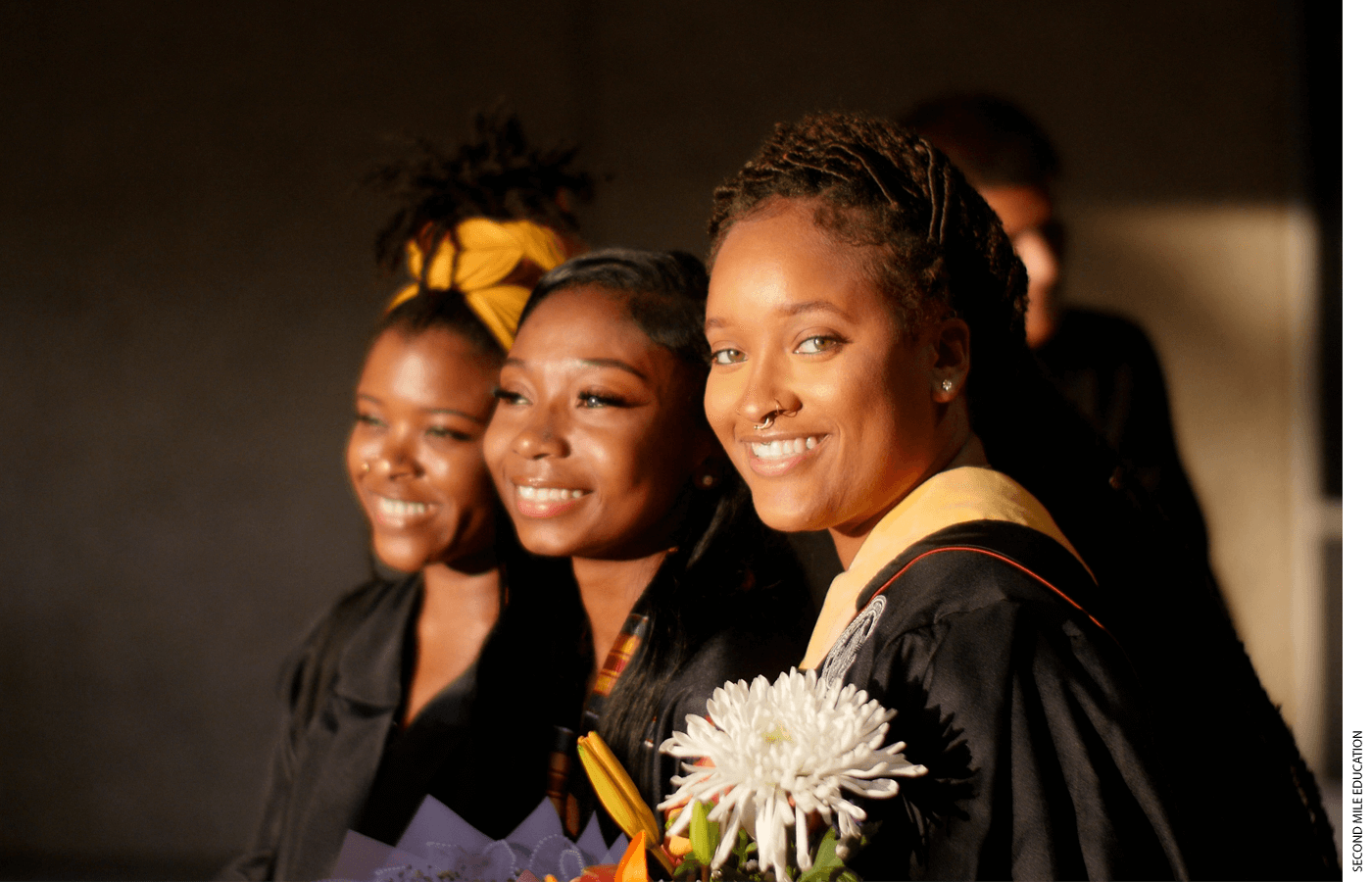
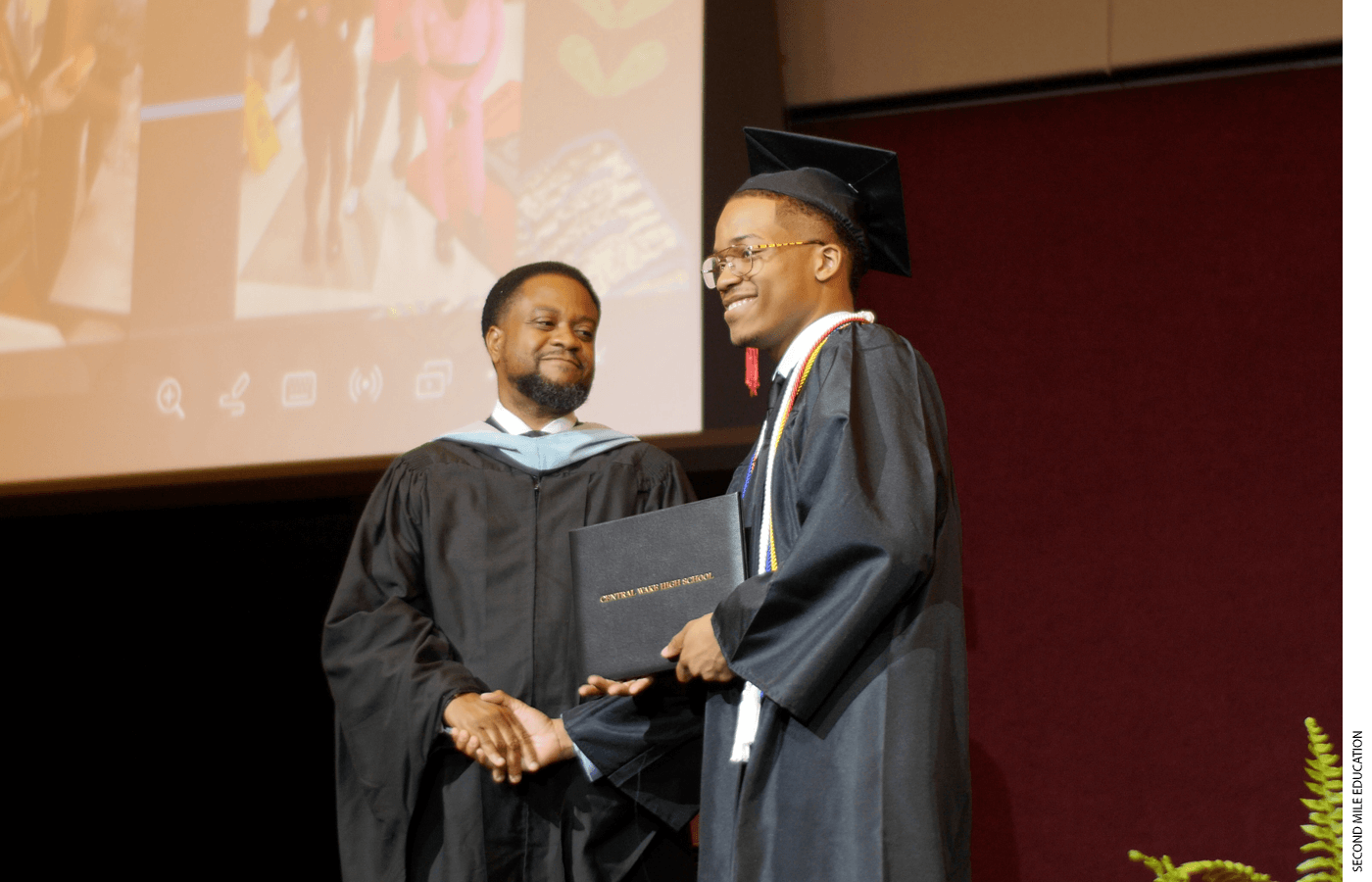
Everyone who has completed their credits is invited back for a diploma ceremony in June. In 2025, all but a few returned—along with their family and friends—nearly filling an auditorium with 1,000 people.
Some students have three sets of caps and gowns hanging in their closets that have never been used, Hanley said. So, when the big day finally arrives, the festivities teem with emotion and pride. Scores of parents, siblings, and loved ones carrying flowers, balloons, and signs pour into the ceremony, and they don’t hold back on their cheers as students’ names are read.
At the ceremony, Tzara Albiter-Acosta, valedictorian of the class of 2025, addressed her classmates, delivering her remarks in English and Spanish. She entered Central Wake two years earlier, determined to work hard and make her family proud after failing in middle school and dropping out for a few years.
“When I think about my time at Central Wake, I think about how it started with self-doubt and uncertainty, and how it turned into one of the most unexpectedly joyful and meaningful chapters of my life,” said Albiter-Acosta, who started at Wake Tech in the fall and hopes to a earn a degree in chemical engineering from North Carolina State University.
“A lot of people talk about success like it’s test scores, but we’ve redefined it,” she told her classmates from the graduation stage. “Success is about learning to ask for help when you need it. It’s about showing up for your friends when they need you. It’s about doing the hard work even when nobody is watching. It’s about having the stubbornness to turn ‘I can’t’ into ‘I can.’”
Caralee Adams is a freelance journalist in Bethesda, Maryland, writing on education, business, technology, health, and other topics for multiple outlets.
Suggested citation format:
Adams, C. (2026). “At-Risk Students Get Second Chance at North Carolina Charter School: Second Mile Education lends connection, support, and a shot at success.” Education Next, 26(1), 3 March 2026.