


February has been a big month for school choice in state supreme courts.
First, the movement claimed a major victory when five Idaho justices unanimously upheld the state’s Parental Choice Tax Credit program. Next, the Wyoming high court heard oral arguments in a challenge to Steamboat Legacy Scholarship Act, an education savings account program enjoined last summer by a trial court.
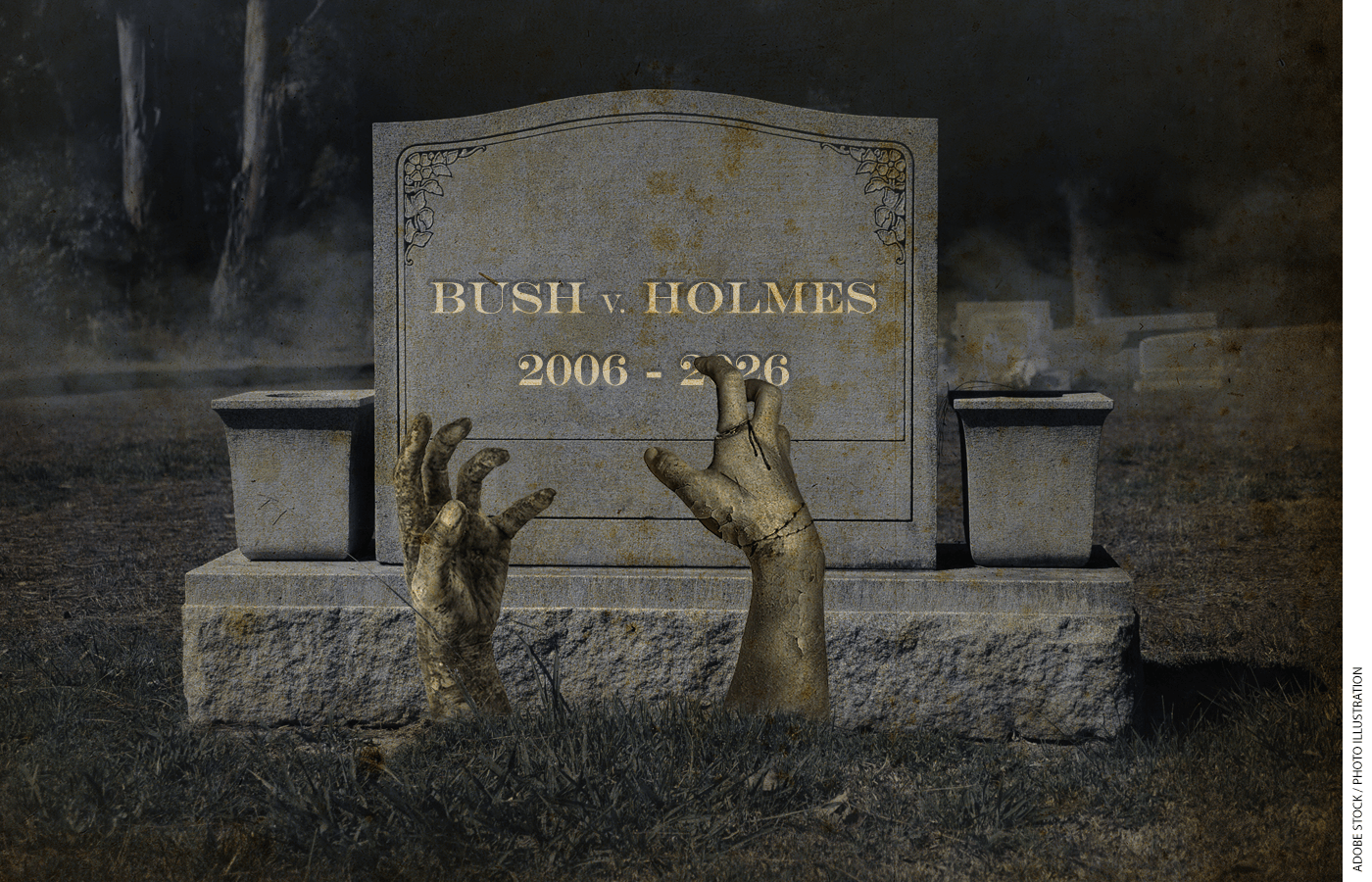
In both cases, opponents of education freedom cited Bush v. Holmes—a defunct, discredited Florida Supreme Court precedent used to keep kids around the country in failing public schools. With apologies to Justice Scalia, this is the story of another legal zombie that, despite being thought dead, “repeatedly sits up in its grave and shuffles abroad,” haunting the legal landscape.
Nowadays, Florida is the very model of a parent-friendly education-choice state. It offers private choice programs, charter schools, magnet schools, homeschooling, and public-school open enrollment. Most important, in 2019 Florida launched the Family Empowerment Scholarship for Educational Options, a multi-use education savings account (ESA) program that provides government benefits to families choosing an array of private education options. To top it off, Florida really went big in 2023 by eliminating income eligibility requirements and enrollment caps on the ESA program.
The results have been dramatic. For the 2025–26 school year, Family Empowerment Scholarships—the universal ESA program and the ESA program for students with disabilities—have a combined 420,758 participating students with average account values of $8,000 and $10,000, respectively.
But today’s successful private-choice programs are strangely detached from Florida’s treatment of choice in legal precedent. That’s because in Bush v. Holmes—which 20 years ago struck down a pioneering voucher program championed by former Governor Jeb Bush—the Florida Supreme Court used contorted reasoning to say that the state constitution’s requirement to maintain “a uniform, efficient, safe, secure, and high-quality system of free public schools” somehow negates private-school choice benefits (see “Florida Grows a Lemon,” Legal Beat, Summer 2006).
With such a precedent to cite, one would have expected opponents of private choice to demand that courts dismantle Florida’s robust ESA program. After all, EdChoice’s Friedman Index—which ranks states based on the size and quality of their education choice programs—places Florida second among all states given its broad participation and generous education freedom benefits.
But no such court challenge comes—likely because Bush, though never overruled, was wrong when decided and has been condemned by better-reasoned decisions in other states. Even before Bush, Wisconsin’s supreme court stated the obvious: When it comes to K–12 education opportunities, traditional public schools are a floor, not a ceiling. Later, Meredith v. Pence (Indiana 2013) and Schwartz v. Lopez (Nevada 2016) expressly rejected Bush. A unanimous Indiana Supreme Court said the state’s duty to provide public schools “cannot be read as a restriction” on promotion of education more generally, including through private choice programs. In its recent decision, the Idaho Supreme Court didn’t even bother acknowledging Bush.
EdNext in your inbox
Sign up for the EdNext Weekly newsletter, and stay up to date with the Daily Digest, delivered straight to your inbox.
Those decisions lay bare the lack of legal support for invalidating private-choice programs using state public education guarantees. And Florida’s universal expansion of private-choice programs has rendered Bush an utterly impotent precedent in the state.
Yet, according to opponents of private choice, Bush should be treated as viable precedent everywhere else. Not only in Idaho and Wyoming, but also Ohio, Tennessee, and Utah, opponents have sued to stop private-choice programs, citing Bush as a paragon of constitutional analysis. They tell courts, “Be like Florida”—of two decades ago, that is. They ignore current programs as if Florida law is a cafeteria from which judges in other states can take what they like and leave the rest.
With Bush’s 20th anniversary, it is time for school choice opponents to put up or shut up. If they believe Bush remains on solid footing, they should not let Florida operate an illegal program. Otherwise, they should stop citing Bush in other states.
No legal challenge in Florida will come, of course, because school choice opponents know they would lose and Bush would be expressly overruled. Robust private-school choice in Florida is simply the price they are willing to pay for resurrecting their favorite precedent’s corpse in other states.
Bush v. Holmes at 20: A legal zombie that should stay interred—in Florida and elsewhere.
Thomas M. Fisher, a former Indiana solicitor general, is executive vice president and director of litigation at EdChoice Legal Advocates, which, along with Institute for Justice, represents parent intervenors in Wyoming Education Association v. Degenfelder.