



By many measures, contemporary Britain is a grim place and getting grimmer. The economy is stagnant, joblessness and welfare dependency are surging, and the population is increasingly despondent and restive. Shabbiness and disorder are the default settings. It’s even raining more. But there is one indicator of national vitality that has risen in recent times: the quality of England’s schools.
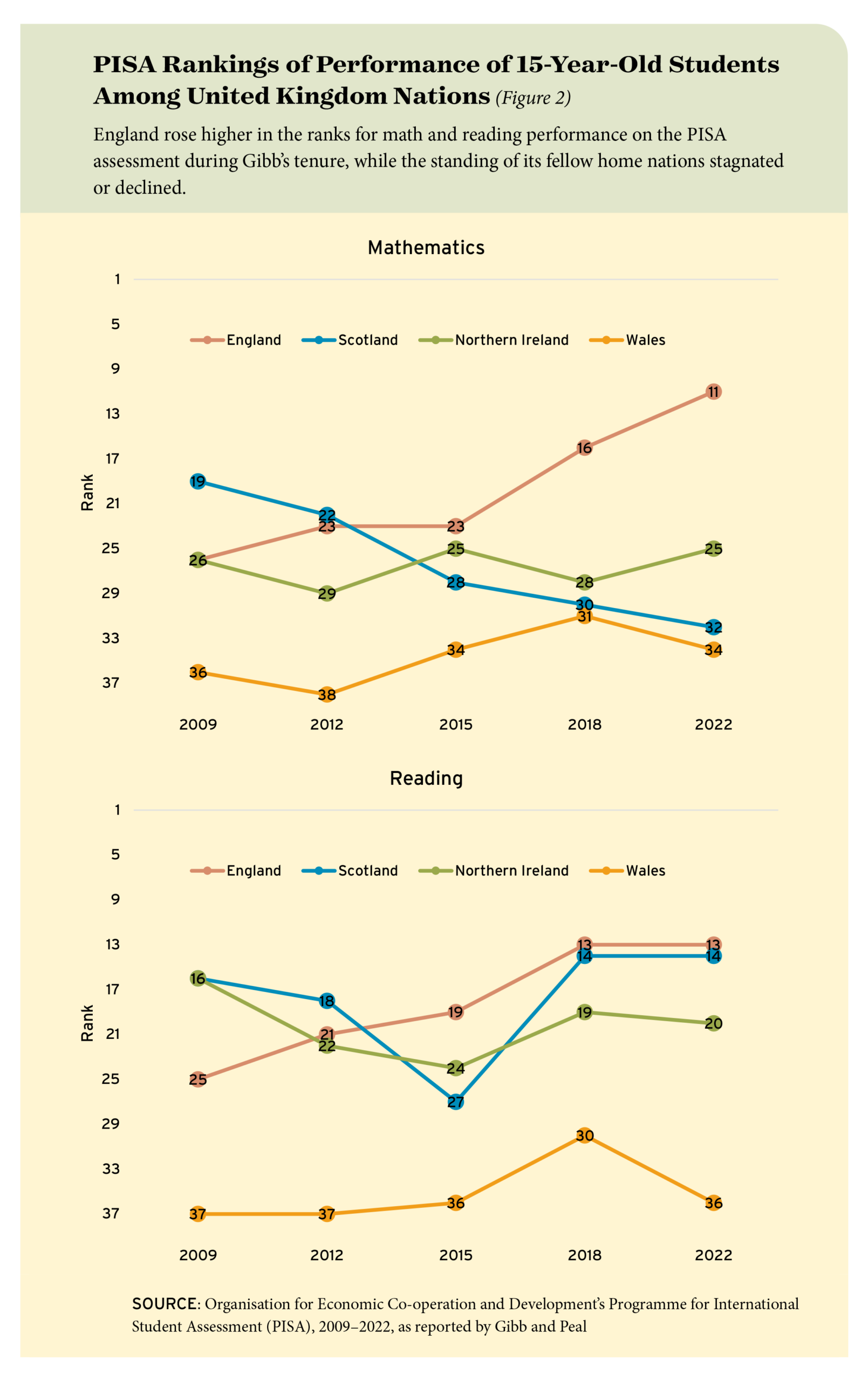
According to the last round of PIRLS testing, English children are the best readers in the western world. On the most recent round of PISA testing, England ranked 11th in the world for mathematics, up from 26th in 2009, with similar improvements in reading and science.
A new book by Sir Nick Gibb—England’s Minister for Schools between 2010 and 2023—and his erstwhile aide, Robert Peal, provides a fascinating and instructive account of how and why England’s schools improved during this period (see Figure 1).
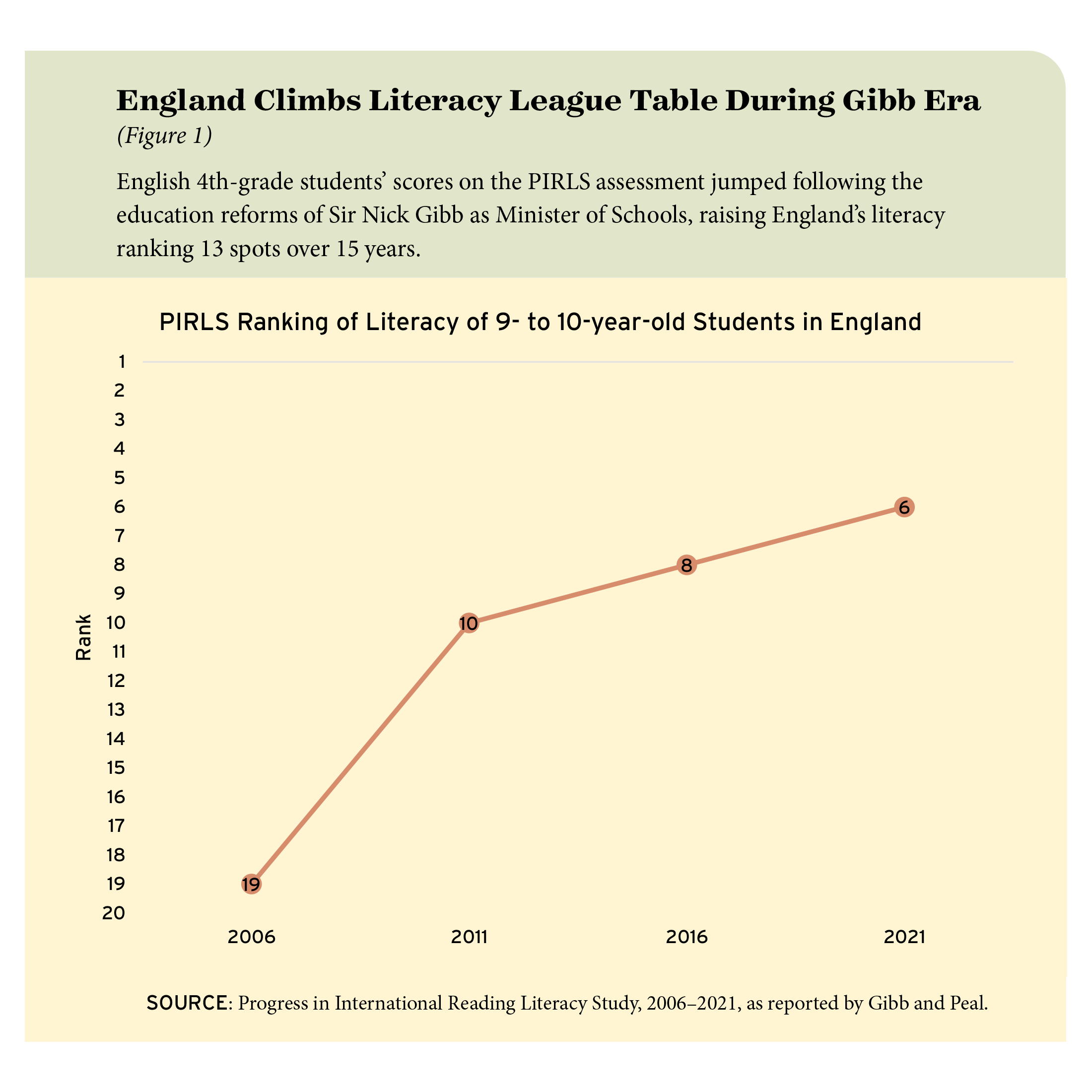
Veterans of mid-noughties Finland mania may look askance at any PIRLS/PISA-based boosterism of a national education system. After all, in the wake of Finland’s stellar performance on the inaugural round of PISA testing in 2003, a whole industry sprang up devoted to studying, venerating, and emulating the purported drivers of Finnish excellence. Yet as of 2022—the latest round of PISA testing—Finland’s performance had declined more than any other country.
The case of Finland is a good reminder of Jay Greene’s maxim that “best practices are the worst” and that selecting on the dependent variable (i.e., studying only successful cases when attempting to discern the drivers of success) is sloppy social science.
But the English story differs in at least three respects from the just-so tales and spurious projections onto domestic debates that Finland engendered some 15 years ago. And Gibb and Peal’s Reforming Lessons is not just a bit of post-hoc self-aggrandizement from a retired politician and his former factotum.
First, a hallmark of good social science is the “pre-registration” of hypotheses before experimentation. Unlike Finland, the authors of England’s reforms posited their theory of change ex ante. Gibb, together with Michael Gove (the Secretary of State for Education until 2014), assumed office in 2010 with a detailed program for reform. The key planks of the plan included raising entry standards for publicly funded teacher training programs and the expansion of Teach First (the British analog of Teach for America); mandating systematic synthetic phonics; adopting a K–12 curriculum organized around recognized disciplines and bodies of knowledge; overhauling examinations and accountability measures and norming them to the most rigorous education systems worldwide; promoting teacher-led, explicit instruction; supporting stronger school discipline; and a massive expansion of academies and free schools (akin to charters).
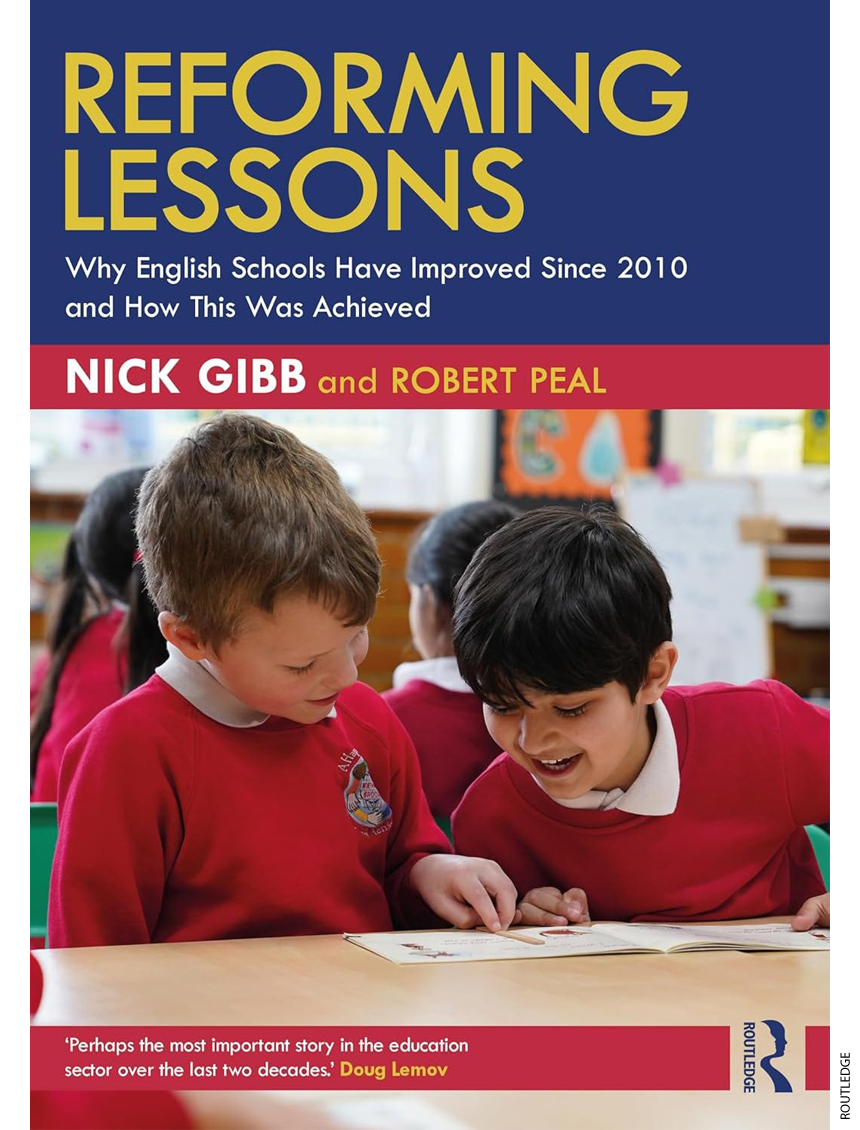
by Nick Gibb and Robert Peal
Routledge, 2025, $21.59, 262 pages
Undergirding this platform was an abiding conviction that a “Rousseauian ideology of progressive education was the fundamental problem in English schools. From the teaching of reading and maths, to the content of the wider curriculum, to pedagogy in the classroom, not to mention classroom configuration and behavior policy, ideological progressivism was driving practice. And it was failing.” Overhauling this orthodoxy, they posited, would arrest England’s “slide down the world league tables in reading, mathematics and science.”
In Finland, by contrast, no such evaluation or responsive action took place. In the wake of its 2003 PISA triumph, prominent exponents of the Finnish model blithely asserted that they “never set out to win a high ranking among the nations. That just happened.” Finland’s performance nonetheless occasioned no shortage of post-facto explanation—much of it unsubstantiated, if not entirely spurious.
Second, the English system steadily improved over more than a decade, and this improvement aligns temporally with the major reforms of the Gibb-Gove era. Finnish mania, on the other hand, was sparked by a single snapshot (the 2003 PISA results) from which no solid causal inferences could be drawn.
Finally, comparative data further bolsters the claim that Gibb and co.’s reforms positively affected the quality of English schools. Between 2010 and 2024, the constituent nations of the United Kingdom ran something of a natural experiment in education policy. While England embraced phonics, a knowledge-rich curriculum, explicit teacher-led instruction, and greater school autonomy, Scotland and Wales eschewed the evidence on early literacy instruction, doubled down on national curricula focused on the acquisition of amorphous “generalizable” skills, and promoted self-directed “discovery” learning as state of the art. During this period, the international metrics show that England forged ahead, while its fellow home nations stagnated (see Figure 2).
Strangely, London’s gritty outer boroughs and the dowdy post-industrial towns of northern England haven’t attracted the same levels of edu-tourism and breathless fascination that Finland garnered in its heyday. That’s probably for the best. But aspiring reformers the world over would do well to familiarize themselves with the English example. Indeed, several already have to apparently good effect. What, then, are the key English lessons?
Lesson 1: Good Policy is Patient Policy
Taken apart, none of the Gibb-Gove reforms were especially novel. The research backing for teacher-led direct instruction and synthetic phonics has been compelling for more than 50 years (paltry implementation notwithstanding). The importance of cultural literacy and cognitive load theory to developing sound curricular and instructional design is also long established. Charter schools (the U.S. analog of England’s academies and free schools) are more than 30 years old, and it was in fact Gibb’s Labor predecessor, Andrew Adonis, who first introduced academies to England in 2007, inspired by an earlier, limited foray into independently administered state-funded schools by the Thatcher government.
The Gibb-Gove program was remarkable not because it was innovative (though it was certainly countercultural) but because it brought all these elements together in an unusually coherent and sustained fashion. Its logic and longevity are all the more notable given the 2010–2024 Conservative government was otherwise characterized by chaos and churn. When most ministerial tenures were measured in months and days, Gibb was in post for more than a decade.
This simple fact of duration was doubtless an enabling condition for what was achieved. It allowed Gibb and his advisors to develop a sophisticated understanding not just of what changes were needed but also what impediments had to be overcome to implement them. Over time, evidence of efficacy accumulated and was deployed to rebuff rearguard attacks and attempts to restore the status quo ante.
The introduction of synthetic phonics as the universal, foundational method for teaching reading in all English schools is a case in point. Gibb and Gove’s general approach was to set high bars (through high-stakes exams, curriculum standards, and public accountability metrics) but otherwise let schools determine how best to meet them. Mandating phonics-based instruction was the exception to this rule for two reasons: (1) The evidence on the efficacy of phonics was unequivocal; and (2) reading by age 6 is foundational to so much else. “It had to be phonics first, fast, and only.”
But, as any casual observer of education reform knows, mandating something is one thing, take-up is another. Gibb’s phonics push worked because it provided free, carefully vetted resources for retraining teachers; created a simple, externally validated measure of compliance—a compulsory, universal Phonics Screening Check at the end of Grade 1—and made judicious concessions to the teaching profession on publishing school-level testing data, thereby preserving a powerful interest group’s acquiescence to the program.
In 2012, the first year the phonics check was administered, 58 percent of students passed. By 2018 the passing rate had risen to 82 percent. A 2021 study by University of Oxford academics found a positive correlation between performance on the Grade 1 phonics screening and performance on PIRLS 2021 at Grade 5. Moreover, there was evidence that it had helped to narrow reading performance gaps between girls and boys and the highest and lowest achievers. Armed with such evidence, Gibb was able to fend off the naysayers—of whom there was no shortage, including the UK Literacy Association!
Gibb’s tussles with the education establishment over phonics and much else lead him to conclude that “the battle of ideas is never won” and that any minister who wishes to change things fundamentally cannot “assume that others will carry out the painstaking work of policy implementation as effectively as is needed. . . . On the policies that mattered most, I had to challenge everything.”
Lesson 2: Expertise Matters
The second reason that Gibb and Gove were unusually effective was that both assumed office as genuine subject matter experts. An accountant by training, Gibb had completed nearly a decade’s apprenticeship in the education portfolio before he entered government—first as a member of the Education Select Committee and then as Shadow Schools Minister. Throughout this period, he spent innumerable hours visiting schools, observing lessons, and speaking with teachers. He also immersed himself in the academic literature on cognitive load theory, early literacy acquisition, and teacher-led instruction.
This dedication to mastering the brief was reflected in Gibb and Gove’s eventual prescriptions for England’s National Curriculum. Here, too, the cultivation of knowledge was the preeminent aim.
The National Curriculum Gibb and Gove inherited was anchored around “competencies” and “general skills.” Specific content knowledge prescriptions were almost entirely absent. For instance, the geography standards did not name a single geographic area except for the European Union. They instead advanced concepts such as “physical and human processes” and “cultural understanding and diversity.” Likewise, the history standards made sparse mention of specific events, focusing instead on “chronological understanding,” “change and continuity,” and “cause and consequence.”
Such an approach is superficially plausible—especially in an age of Google and AI—but it contravenes the science of human cognition. “Critical thinking” and “problem solving” are not generic skills that can be transferred seamlessly across contexts. To think critically, one needs specific knowledge to think about. Our working memories are highly limited, so we depend on facts stored in long-term memory to be able to think. Ergo, committing facts to long-term memory must be an essential goal of education.
Armed with this understanding, Gibb and Gove launched a radically different National Curriculum that inverted the hitherto prevailing emphasis on skills over knowledge. Their 2014 curriculum was more challenging, much more specific—with a coherent and detailed sequence of knowledge for each subject—and deliberately narrower than any that had preceded it.
A similarly exacting approach was taken to qualifications reforms to ensure students would actually learn and remember what the new National Curriculum required. When one of Gove’s colleagues questioned the necessity of all secondary school English Literature students studying a 19th century English novel, he received the following reply: “The Secretary of State insists on this prescription because the nineteenth century represents the most important period for the novel as a cultural form. . . . A student of English Literature who hasn’t studied a nineteenth-century novel is like a student of maths who hasn’t studied multiplication.” Such clarity and rectitude are rare in the fad-addled world of K–12 education.
As Daisy Christodoulou writes in a compelling foreword to Reforming Lessons, “if there is any general principle to be drawn from this book, it’s that generalists have their limitations. Content knowledge is king, whether that’s in the classroom or in ministerial office.”

Lesson 3: Structures Matter, but Ideas and Agents Matter More
Before Gibb and Gove took the helm of education policymaking, the Conservative party had fixated on structures, with social conservatives urging a return to academic selection and grammar schools and libertarians pushing vouchers, privatization, and greater market competition. Little was said about curricular content (aside from the occasional culture war skirmish) and even less about evidence-based instructional practices.
Gove and Gibb changed all that. They recognized that what happens within the four walls of a classroom is everything, and that grammar schools and vouchers would have no effect on the “thought world” and capacities of the teaching profession.
Per Gibb: “The key issues were not school funding or inequality, or too much or too little sex or financial education or the need for more or less discussion about climate change or the cost of school uniforms. The overwhelming issue was the progressivist ideology, particularly when it came to the content of the curriculum and the approach to teaching.”
But prioritizing ideas and practices didn’t mean neglecting structures. Indeed, the Gibb–Gove years saw a massive expansion of academies (from 5 percent of secondary schools in 2010 to 83 percent of secondaries and 43 percent of primaries today). Liberating schools from the control of local educational authorities (akin to US school districts) was not an end in itself, however. It was rather the means to empower an army of frontline agents primed to demonstrate that the Gibb–Gove heterodoxy was superior to establishment progressivism.
Academization created opportunities for enterprising, countercultural educators like Katharine Birbalsingh, Daisy Christodoulou, Michael Wilshaw, and Dan Moynihan to create schools and school networks (a.k.a. multi-academy trusts) founded upon knowledge-rich curricula, explicit teaching, and warm-strict behavioral cultures. Gibb’s coauthor typifies this phenomenon. A veteran of Teach First, Robert Peal returned to the classroom after a stint in central government as Gibb’s key aide and now presides over the West London Free School, which is among the best performing in the city.
EdNext in your inbox
Sign up for the EdNext Weekly newsletter, and stay up to date with the Daily Digest, delivered straight to your inbox.
An overhauled accountability system that focused not just on raw proficiency but also on academic progress (particularly that of the most disadvantaged students), soon showed the efficacy of these new endeavors. Concurrently, networks of teachers sprung up to disseminate evidence-backed practices, thereby circumventing the erstwhile ideological and epistemological gatekeeping of university education faculties. Much of the momentum for these changes came from Teach First and other alternative pathways, which were massively expanded and drew legions of ambitious heterodox people into the sector, creating a parallel workforce and set of organizations. Put another way, a top-down agenda became the bottom-up project of a critical mass of frontline agents because a structural change had given them purchase on a previously closed system.
Limitations of the Gibb–Gove Legacy
Of course, no administration is perfect, and critics argue that despite the gains in headline figures, Gibb’s tenure was also characterized by crumbling school buildings and insufficient support for pupils with special educational needs. Teacher recruitment and retention were persistent unresolved problems, and early scandals in the process of creating academies might have been avoided by more careful vetting of operators and financial controls. Gibb and Peal briefly acknowledge these shortcomings in the book.
It is also unclear how much of the Gibb legacy will endure now that Labor is in office. Phonics-based instruction and the Grade 1 phonics check appear safe; likewise a commitment to a “knowledge-rich curriculum.” On both counts, Labor’s Education Secretary Bridget Phillipson has said she would be “led by the evidence.” On the other hand, academies look set to lose key freedoms over teacher recruitment, pay, and conditions, and there is a moratorium on the creation of new independently operated state-funded schools. Labor has also cut programs introduced by the Conservatives that supported state schools to offer advanced mathematics, Latin, and the International Baccalaureate, earning the Education Secretary a new sobriquet from The Spectator magazine: Bridget Philistine.
Why Americans Should Read This Book
The lessons of Reforming Lessons are highly generalizable—especially at the level of U.S. state governments. The Gibb–Gove playbook is essentially the same one that’s fueled the recent “Southern Surge” in the U.S. Moreover, there’s a piquant irony that many of the convictions and methods that underpinned the reforms of Gibb et al. were derived from American research. As Gibb recently recounted to Greg Toppo of The 74, “[E.D. Hirsch’s The Schools We Need and Why We Don’t Have Them] just explained everything I was instinctively feeling about our school system. . . . [It] really formed the basis of our reform programming from 2010 onwards.” Daniel Willingham, the University of Virginia psychologist and leading proponent of ‘cognitive load theory’ was also a major influence, along with Doug Lemov, of Teach Like a Champion fame.
Furthermore, one of the most compelling aspects of Reforming Lessons is that there’s nothing inherently conservative about the key reforms that were pursued. Phonics, knowledge-rich curricula, and warm-strict behavior codes are all supported by modern cognitive science. Moreover, they are the foundation of any school system capable of equalizing opportunity for the least advantaged. Across the western world, true progressives (not to be confused with proponents of progressive education) should be tripping over themselves to emulate Gibb’s record.
Kudos to Rahm Emmanuel for his recent trip to Hattiesburg, Mississippi, whence he issued a call to make “what’s working in Mississippi, Tennessee, and Louisiana the national standard.” Massachusetts’s recent adoption of robust science of reading measures is likewise encouraging (notwithstanding the staunch opposition from the Massachusetts Teachers Association). Perhaps someone can slip New Jersey governor Mikie Sherrill a copy of Reforming Lessons? If Louisiana and Mississippi aren’t compelling case studies for her, maybe England could be.
Helen Baxendale is a writer and education researcher from Phoenix.
Suggested citation format:
Baxendale, H. (2026). “What American Education Reformers Can Learn from England: Conservative education minister’s new book offers a roadmap for aligning practice to evidence.” Education Next, 26(1), 19 February 2026.