


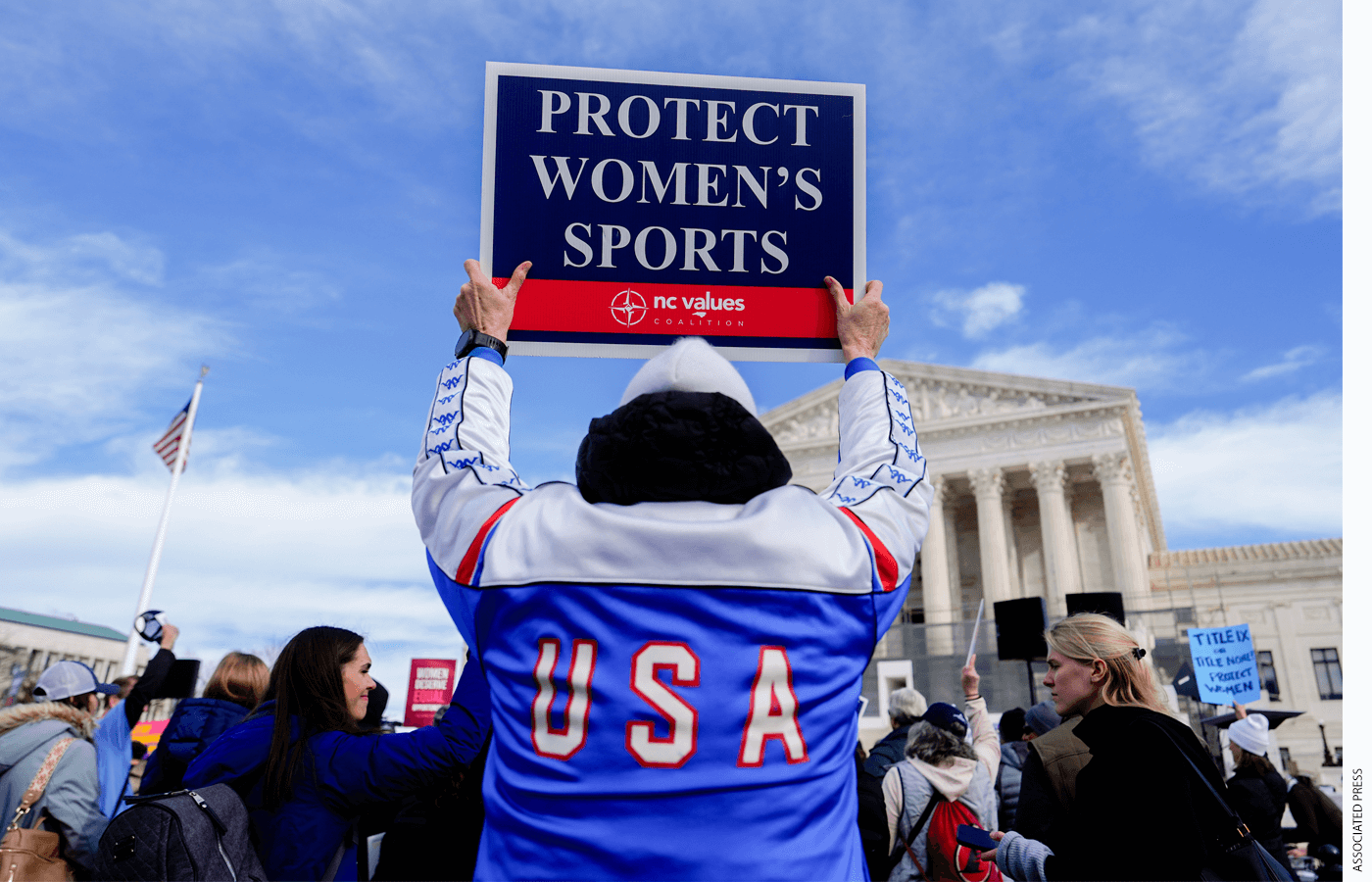
On Tuesday, the Supreme Court heard oral argument in two closely watched cases on whether state prohibitions on males competing in women’s sports violate the Equal Protection Clause of the 14th Amendment (in Little v. Hecox) or Title IX (in West Virginia v. B.P.J.). While predictions based on oral argument are always hazardous, the court appeared likely to uphold both statutes. The biggest question may be whether the court’s rulings will prevent any state from allowing transgender females to participate in women’s sports.
Little v. Hecox is a challenge to Idaho’s 2020 Fairness in Women’s Sports Act, which forbids biological males from participating in women’s sports in public schools from K–12 through college. The law does not explicitly single out transgender students, but its effect is to prevent those identifying as transgender females from participating in women’s sports. The challenger, Lindsay Hecox, had earlier dismissed claims against the state, citing unwanted attention, a parent’s death, and personal illness, and in September asked the court to dismiss the case as moot. Not insignificantly, the request came after the court’s decision last June in U.S. v. Skrmetti, which upheld Tennessee’s prohibition on providing puberty blockers or hormone therapy for minors with gender dysphoria, signaling its likely unwillingness to declare gender identity a protected class. In October, the court declined to act on Hecox’s mootness request before argument, and on Tuesday, it appeared to receive support only from Justices Sotomayor and Jackson. This suggests the court will decide the constitutional question, and likely in favor of Idaho.
One issue made that clear. Justice Gorsuch asked whether gender identity qualifies as a “discrete and insular class,” which would make it a suspect class subject to strict scrutiny under the Equal Protection Clause. However, Hecox’s attorney admitted that the state could prohibit transgender students from participating in girls’ sports if they had not mitigated biological advantages through puberty blockers and hormone therapy. Given the court’s exacting requirements for identifying as a discrete and insular minority, individuals in such a category would find it extremely difficult to qualify as one and be entitled to strict scrutiny. And since the court didn’t bestow the label of protected class in Skrmetti last year, it seems unlikely to do so now for a small subset of a small class.
With victory in Hecox looking unlikely, opponents of transgender-athlete restrictions could only hope that the Title IX complaints in the second case, West Virginia v. B.P.J., would fare better. They had reason to be optimistic. The Court’s 2020 decision in Bostock v. Clayton County, written by Justice Gorsuch and joined by Chief Justice Roberts, held that Title VII’s prohibition on employment discrimination “because of sex” includes sexual orientation and gender identity. That optimism likely evaporated during argument. Justice Gorsuch made it clear that, in his view, the Javits Amendment added to Title IX in 1974 changed the law and recognized the distinctiveness of sports, permitting sex-based differences. For Gorsuch, Title IX uses biological sex, and the Javits Amendment explicitly extended the statute’s coverage to intercollegiate athletics based on “the nature of particular sports,” a principle later applied to public schools through agency regulations.
EdNext in your inbox
Sign up for the EdNext Weekly newsletter, and stay up to date with the Daily Digest, delivered straight to your inbox.
B.P.J., the now-15-year-old plaintiff challenging West Virginia’s law, who had taken puberty blockers and hormones, fared no better with the other conservative justices. Chief Justice Roberts and Justice Alito both expressed bewilderment when B.P.J.’s attorney, Joshua Block of the American Civil Liberties Union, asserted that the court need not define sex under Title IX. Alito bluntly replied, “It must mean something. You are arguing that, here, there’s discrimination on the basis of sex. And how can we decide that question without knowing what sex means in Title IX?” Justice Barrett asked whether, under Block’s logic, forbidding a boy who lacked sufficient athletic skill to play on boys’ teams from playing on girls’ teams would also violate the law.
But the most ominous comments for B.P.J. came from Justice Kavanaugh. In both cases he noted that sports are inherently zero sum, because if a biological male takes a spot on a girls’ team, a girl necessarily loses a spot. When questioning West Virginia Solicitor General Michael Williams, he went further, asking whether Title IX might forbid any state from allowing biological males to compete in female sports. Then, to Hashim Mooppan, the Deputy Solicitor General representing the Trump Administration, he observed that the accepted practice of separating boys’ and girls’ teams “may be even required, in my view, to have equal girls’ teams.” If four other justices share Kavanaugh’s position, the court may issue an opinion that says or strongly implies that Title IX requires excluding transgender athletes from girls’ sports.
Given the court’s line of questioning, the best hope for Hecox and B.P.J. might be that it ultimately decides not to set a national rule but rather to allow states to experiment. Justice Gorsuch expressed sympathy because of past discrimination, making it possible he would be in favor of a narrow ruling, while Justice Kavanaugh seemed skeptical that the court should “constitutionalize a rule for the whole country.” However, such deference to the states is unlikely to last. At some point, as Roberts and Alito pointed out, the word sex must mean something, and there are already cases in the lower courts where female athletes have challenged transgender participation as a violation of Title IX. Those disputes will only multiply until the Supreme Court establishes a clear rule.
Once it does, those who would like states to be able to establish different policies on transgender athletes’ participation in sports would need to ask Congress to revise Title IX. But that would be a significant challenge when polls indicate that two-thirds to three-quarters of Americans believe students should play on teams that match their biological sex. Federalizing public policy, it turns out, cuts both political ways.
Joshua Dunn is executive director of the Institute of American Civics at the Baker School of Public Policy and Public Affairs.
Suggested citation format:
Dunn, J. (2026). “Supreme Court Considers Status of Transgender Athletes: Oral argument indicates intention to uphold state bans and possibly rule that Title IX requires exclusion nationwide.” Education Next, 26(1), 14 January 2026.