



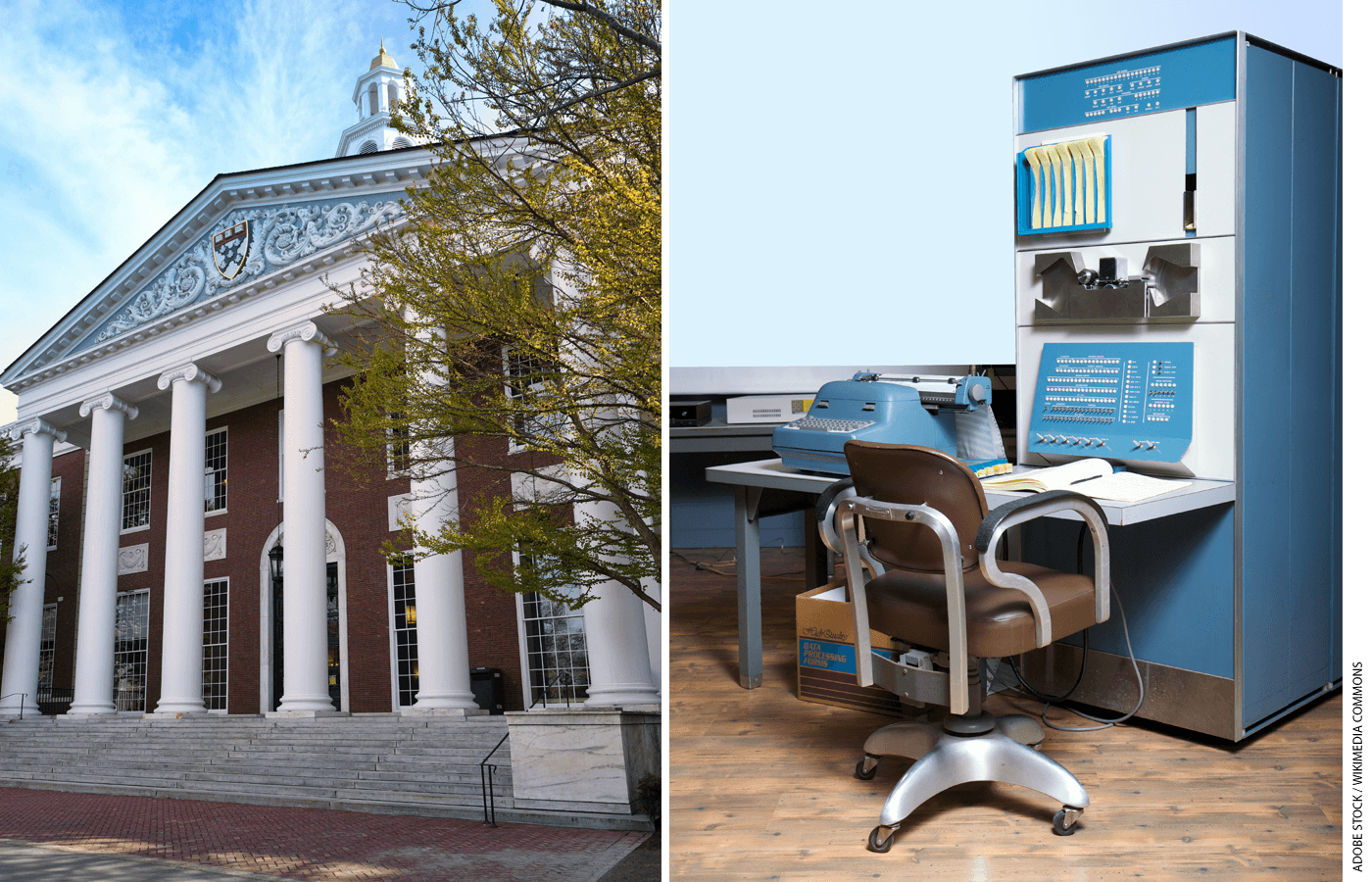
Even as undergraduate enrollments have rebounded in raw numbers since the pandemic, the percentage of high school graduates choosing to enroll in college has slipped precipitously—by nearly 10 percentage points (from 70.1 to 60.4 percent) between 2009 and 2023. Broad skepticism exists that the degrees those tuition-paying young people seek are worth the time, cost, and effort. More states are also walking away from the “College for All” goal and putting career and technical education on par with college. If these trends continue, the open question is what comes next for higher education?
We see one possibility: an alternative approach that would keep the four-year college degree as a goal for most, but not in its current form. This vision would reinvent undergraduate study as career-connected learning by offering a variety of direct pathways to good jobs and choice-filled lives. This version of college would be less classroom-based, closer to careers, more affordable, and with little to no opportunity cost.
Early proof points exist. One of us (Joe) leads Reach University, an accredited nonprofit institution where 900 students so far have earned undergraduate degrees on the job as part of a paid apprenticeship. New Jersey has started to design something similar, and states like Michigan and Tennessee have launched teacher-preparation programs that allow aspiring educators to earn bachelor’s degrees while working in the classroom.
But for now, undergraduate apprenticeship degree programs are the exceptions, not the rule. Whether “College for All” and “Career-Connected Learning for All” can embrace each other more firmly—and then scale—remains to be seen.
Who Needs This? A Tale of Two Industries
We’ve seen the anti-college backlash before.
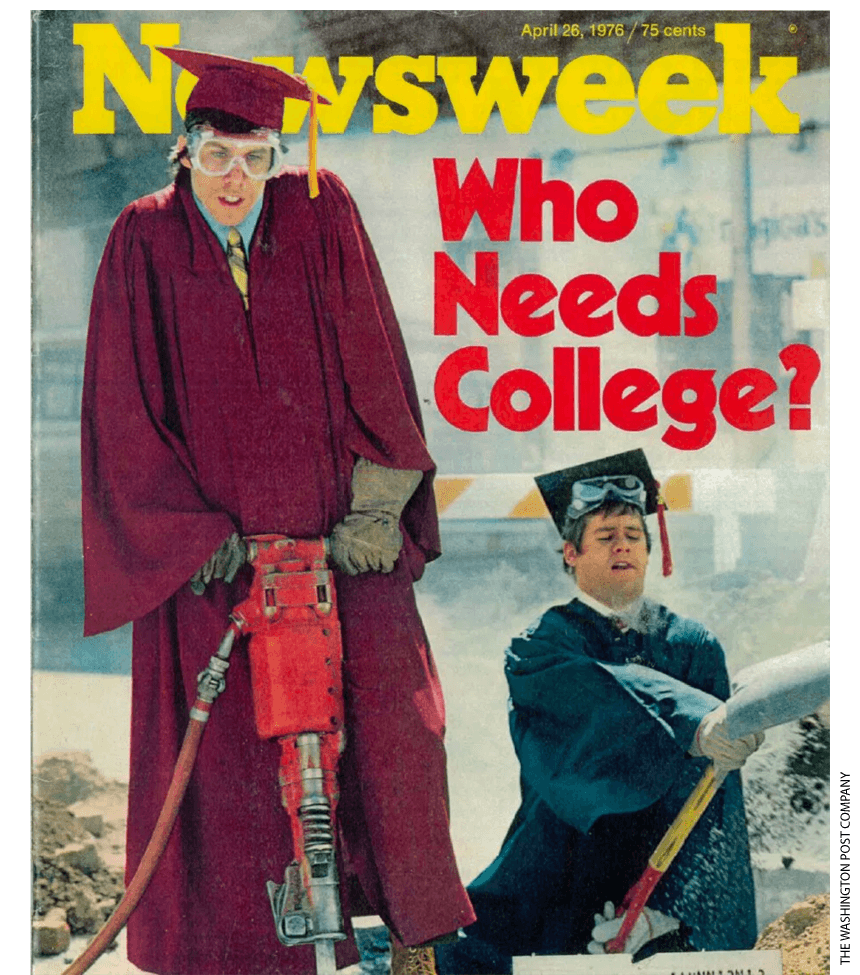
In 1976, an issue of Newsweek featured a provocative cover story: “Who Needs College?” The themes will sound familiar. Amid stagflation and a tough job market for new graduates, the article reported on the declining value of a degree and rising public misgivings about pushing every high schooler down one narrow pathway.
Education wasn’t the only sector facing doubts about whether everyone needed access. In 1977, Ken Olsen of Digital Equipment Corporation (DEC), the leading computer company of the era, infamously declared there was “no reason for any individual to have a computer in their home.” His company may have pioneered the minicomputer, but it would soon face a market tsunami that might appropriately be dubbed “Computers for All.”
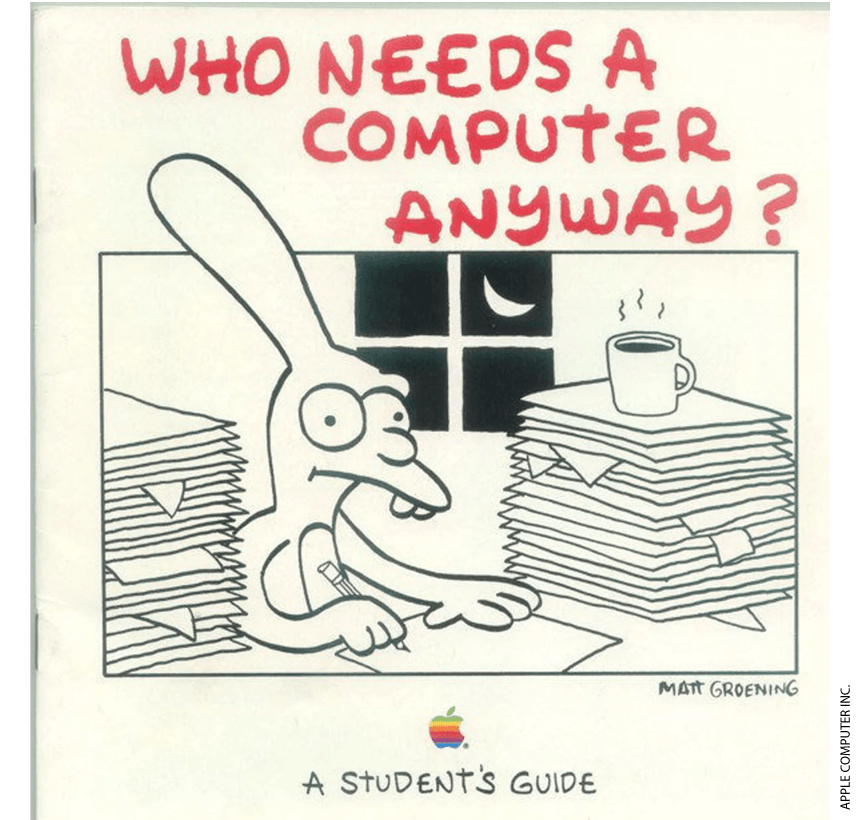
The storm took its time to land. As late as 1989—the year DEC’s public collapse began—people still needed convincing that the home computer belonged in daily life. That year, Matt Groening (who in December would graduate his Simpsons characters from shorts on The Tracey Ullman Show to a debut in their own animated series), drew Bongo the one-eared rabbit as a pitchman in an Apple pamphlet titled Who Needs a Computer Anyway?
Today, that question makes sense only as an act of irony or iconoclasm.
The year 1989 turned out to be a hinge for both college and computers. More Americans held a bachelor’s degree that year (21 percent) than American households had a home computer (15 percent). Over the next three decades, access to both became a rallying cry. Bachelor’s degree attainment roughly doubled to 39 percent. Computer ownership grew more than sixfold.
Bongo’s question was meant to make a case for the computer, and within a generation the thing was universal. Will the same trajectory follow today’s obituaries for College for All? Some leading voices now say the approach hasn’t worked, was never going to work, and maybe wasn’t such a good idea to begin with. Education Design Lab founder Kathleen deLaski, who used to be on the College for All bandwagon, now imagines a world where degrees matter much less. The title of her widely read (and debated) 2025 book on the topic intentionally echoes the 1976 Newsweek cover: Who Needs College Anymore?
But as in 1976, the data today don’t support that conclusion. The investment return on a four-year college degree versus most short-term credentials remains, on average, in favor of a degree. Meanwhile, some commonly championed postsecondary alternatives are starting to acquire the very dysfunctions that tarnished college. For example, as demand for the trades has begun to outstrip the capacity of community colleges and apprenticeships, students are being pushed into private trade schools, where tuition runs tens of thousands of dollars.
Despite public disillusionment, the conditions haven’t yet seriously allowed for the reinvention—and disruption—of the undergraduate degree itself. One reason may be that we aren’t asking the right questions about college.
Disruption and Affordability
Through “disruptive innovation,” products and services that were previously complicated, expensive, and inaccessible become simpler, convenient, and affordable—such that they serve many more people. It’s a process that has played out in nearly every industry, from computing to air travel to retail.
The evolution of personal computing presents a lesson in disruptive innovation. DEC’s Ken Olsen was right that no one would want a home computer, but he meant the so-called minicomputers DEC made at the time. A minicomputer, for those who don’t know, cost roughly $250,000 and was the size of a large filing cabinet. It was also incredibly complicated and technical to use. Most modern consumers would have no clue how to operate it. But companies like Apple created lower-cost, easy-to-use machines for the masses, and today 95 percent of U.S. households have at least one computer.
If Apple, Microsoft, and the others promulgating the vision of “Computers for All” had adopted the approach we took with College for All, they would have done some version of asking an outside entity (likely the government) to subsidize ownership of a $250,000 machine. DEC also would have helped set up entities to restrict the entrance of new computer companies with different value propositions in the name of “quality”—akin to accreditation.
That would have allowed individuals to afford monstrous, expensive, complicated machines made by brand-name companies that most people couldn’t use. It would have been insane.
Instead, the advent of the desktop computer—at one time called the microcomputer—dramatically lowered the cost of ownership to about $2,000 and radically simplified its utility. Subsequent disruptive innovations such as the laptop and later the smartphone have further lowered the cost, increased the convenience, improved the ease of use—and made computers both indispensable and ubiquitous.
Can we do the same for college?
Reinventing College
The disruptive innovation playbook would have us ask what a college degree is and should be, and then introduce something simpler, more affordable, and more convenient. That hasn’t been the approach so far. We have instead followed the education playbook: subsidize traditional colleges in their current form through grants, generous loan terms, and direct payments to schools, all to help people afford a product that—given six-year graduation rates of about 65 percent—remains expensive and difficult to successfully “operate”. And despite claims in some quarters, those subsidies have largely grown over time.
If anything, as Bill Bennett hypothesized, this has caused many colleges to raise costs while taking an Alfred E. Neuman approach to controlling the underlying expenditures in their business model: “What, me worry?”
It didn’t have to be this way. Despite popular perception, American higher education has reinvented itself before.
Harvard was founded in 1636 as a religious institution. Puritan in its roots, it offered a classical curriculum delivered through recitation and disputation (almost entirely in Latin). This served as the model for the colleges born over the next 200 years.
Two forces radically changed the higher education landscape in the 1800s. The federal land-grant acts dramatically expanded the number of institutions. And the founding of Johns Hopkins University in 1876 introduced the modern research university. Existing schools reshaped themselves in response.
EdNext in your inbox
Sign up for the EdNext Weekly newsletter, and stay up to date with the Daily Digest, delivered straight to your inbox.
Since then, reinvention efforts have sputtered. Yes, the GI Bill in 1944 created a surge in demand as the Second World War ended, and community colleges saw dramatic growth. But the college model itself didn’t fundamentally change.
And yes, online universities in the 1990s and 2000s promised something radically different. But as traditional schools began adopting online learning in the 2010s to expand access, they didn’t fundamentally change higher education’s cost equation or the rigidity of their model.
Some colleges that are fundamentally disruptive relative to traditional schools—online universities Southern New Hampshire University and Western Governors University, which are dramatically simpler, more convenient, and more affordable—have found ways to emerge successfully at scale. While these schools have the largest enrollments nationwide, they are the exceptions.
Overall growth has been stunted by traditional institutions co-opting the disruptive market, including through new online and accelerated degree programs. Thanks to their strong reputations, signaling effects, and subsidized loans with deferred payments, they appear to be a good value, even though they are more expensive, cumbersome, and complicated than the online upstarts. Because subsidies have crowded out more affordable entities, new programs look relatively primitive, like the earliest personal computers to hit the market.
So the push for all students to go to college has generally been with the traditional four-year school in mind, or a two-year pathway that bridges to a bachelor’s degree. But it remains expensive, complex, and prone to failure, prompting some education leaders to give more thought to students’ return on investment. The KIPP charter-school network has expanded its goals for graduates to include non-college options. Randi Weingarten, president of the American Federation of Teachers, said College for All was “overly simplistic” and “should no longer be our North Star.”
This backlash could be creating the conditions for a true disruptive innovation strategy in higher education.
A New Path Forward
Despite new regulatory focus on return on investment, in statehouses and the federal One Big Beautiful Bill Act of 2025, higher education still enjoys significant subsidies, grants, and low-cost loans. A disruptive innovation in higher education likely can’t just be a simpler option with lower costs. To have a transformational impact, it must also eliminate the opportunity cost of attending college.
That’s where the apprenticeship degree enters the picture. A dramatic reinterpretation of college, these degrees follow the “ABC” rubric: affordable, based in the workplace, and credit-conferring for learning at work. Apprenticeship degree students are employees, such as a paraprofessional working in a school district. They earn credit for the work they do in their place of employment, which eliminates the opportunity cost of enrollment. Academic material is covered in online coursework, such as synchronous discussions of the liberal arts or pedagogy that builds knowledge and theory students can apply at work.
Institutions like Reach offer limited course pathways—much like Apple under Steve Jobs choosing to focus on fewer products—which helps hold down expenditures. Rather than using government dollars to lower students’ costs, apprenticeship programs following this model have inexpensive tuitions and ensure students are earning money as they learn.
For these programs to thrive, higher education as a sector will need to set some guardrails, lest new entrants simply try to repackage any kind of work-based training, bootcamp, or vocational program as a degree. The challenge here is defining what makes, or should make, higher education “higher.” How should we measure and define an apprenticeship degree’s short-term value—getting a better paid job, for example—and its longer-term, durable benefits? Accreditors will have to figure this out; these are the questions that should be raised for all degrees.
But the conditions are ripe for this type of innovation. With the federal government urging accreditors to become more hospitable to innovation, we can expect new types of colleges to be formed in the years ahead. To respond to concerns about “College for All,” they’ll need to focus on outcomes and value for learners. They’ll need to be disruptive models that wipe away the opportunity cost of attendance with an accessible, simple model that clearly connects to careers. And they’ll have to do this without losing the value proposition that attracts people to a degree in the first place.
The computer didn’t take off by convincing skeptics it was fine as conceived. Instead, it became something different—smaller, cheaper, available in every pocket, and ultimately reinvented from the inside out. The power of the computer wasn’t diminished in the process; instead, it was amplified. In our lifetimes, the bachelor’s degree has largely resisted such radical reinvention. But the pressure is on. It’s time to stop asking “Who needs college?” and instead ask “What should college be?”
Michael B. Horn is an executive editor of Education Next, co-founder of and a distinguished fellow at the Clayton Christensen Institute for Disruptive Innovation, and author of the national bestseller Job Moves. Joe E. Ross is president and CEO of Reach University.
Suggested citation format:
Horn, M. B., and Ross, J. E. (2026). “Reinventing College as Something Everyone Can Use—and Afford: Apprenticeship degrees are ready to disrupt the ‘College for All’ mindset.” Education Next, 26(3), 9 July 2026.