



“If men were angels,” James Madison wrote in Federalist No. 51, “no government would be necessary.” The same might be said of student discipline. If children were naturally orderly, patient, truthful, and inclined to subordinate their impulses to the common good, discipline would scarcely be required. Yet a persistent strain of educational thought—from Rousseau to today’s restorative-justice advocates—suggests that disorder at school arises less from human nature than from the heavy hand of adult authority. Remove punishment, replace hierarchy with empathy, and the child’s better instincts will emerge.
Madison understood something many educators prefer not to: Institutions exist because human beings are not angels. Children are no exception. Yes, they are capable of generosity, curiosity, and grace; they are also capable of cruelty, impulsiveness, deceit, and disruption. The work of schooling has always involved cultivating the former in students while restraining the latter. Any theory of discipline that forgets or denies this begins in sentimentality and often ends in disorder.
Nathan Maynard’s The Science of Discipline is an intelligent and humane expression of this type of disciplinary theory. To be sure, he does not suggest children are angels, but he does ask educators to view misconduct through a different lens. Most behavior problems, he argues, are not signs of defiance or character failure but clues to something deeper: a missing skill, an unmet need, emotional overload, or a breakdown in human connection. Behavior is communication. Discipline, therefore, should begin with curiosity—seeking to understand what a child is struggling to express and helping that child learn more constructive ways of meeting those needs. It is a generous vision, and one that shifts the educator’s role from rule enforcer to diagnostician, mentor, and guide. But by neglecting the role of character and culture in behavior, it ultimately does students a disservice.
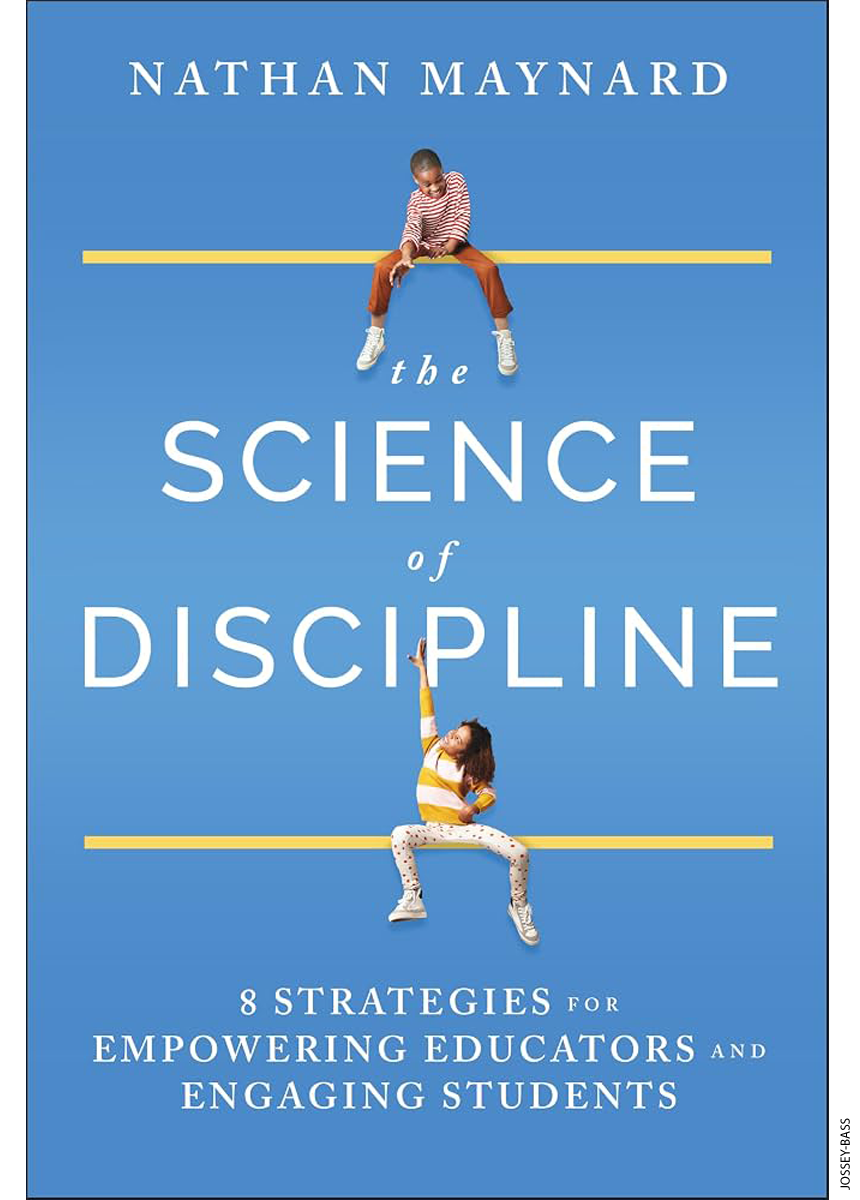
by Nathan Maynard
Jossey-Bass, 2026, $30.00; 240 pages
Unmet Needs or Unformed Character?
One of the more frustrating aspects of The Science of Discipline is that its title is something of a bait-and-switch. The jacket copy promises behavior strategies “supported by groundbreaking research in neuroscience,” but the book is less a scientific treatise than a work of moral and educational philosophy. Its central claims concern what schools are for, how children’s behavior should be understood, and what role adults ought to play in shaping it. Readers will also detect an implicit assumption of Maynard’s that deserves greater scrutiny: that traditional discipline is itself psychologically harmful. Certainly, arbitrary humiliation, abuse, or capricious punishment can wound children. But it does not follow that clear consequences for misconduct are inherently traumatizing. Schools have always asked children to endure manageable forms of discomfort—criticism, failure, correction, disappointment, and accountability—because these experiences are part of growing up. The neuroscience of “trauma” should caution us against compounding genuine adversity, not persuade us that ordinary consequences are a form of it.
The appeal of Maynard’s vision is obvious. It promises a more humane alternative to the false choice between permissiveness and punishment that has long characterized debates over school discipline. Few educators enter the profession eager to punish children, and most can recall disciplinary encounters that escalated conflict rather than resolved it. Contrary to popular caricature, teachers are rarely petty tyrants itching to wield authority. Most are drawn to the work because they genuinely enjoy children and want to see them flourish. A philosophy that asks adults to replace suspicion with curiosity, to seek understanding before judgment, and to view misconduct as an opportunity for growth rather than merely a problem to be suppressed naturally flatters adult sensibilities.
And in many respects, Maynard’s critique of traditional practices lands squarely on the mark. Some of his strongest observations are difficult to dispute. Schools are often inconsistent in their disciplinary practices. Students frequently experience rules as arbitrary and unevenly enforced. Humiliation is a poor teacher. Relationships matter. Children deserve to be treated with dignity, even when they misbehave. These are valuable correctives to genuinely flawed practices.
The problem lies not with Maynard’s views on consistency, dignity, or relationships, but with his understanding of the meaning of behavior itself. If behavior is communication and points to an unmet need, the educator’s task should be to identify and address that need. Traditionalists begin with a different question. They are less likely to ask what behavior is communicating than what the child must learn from it. Both questions are educational, but they point in different directions. The first looks backward toward causes. The second looks forward toward formation. The dispute arises when one or the other is treated as sufficient or suspect.
Maynard’s approach precludes the possibility that some forms of misconduct are manifestations of ordinary human temptations. Children, no less than adults, succumb to impulses of selfishness, dishonesty, cruelty, and the desire to test limits. A theory of discipline that emphasizes understanding these impulses is valuable. A theory that neglects the need to shape and restrain them is incomplete.
The central question of school discipline cannot be what makes adults feel humane. It must be what best serves children over time. Schools are among the first institutions where young people learn that freedom is bounded by obligations to others, that impulses must sometimes yield to shared norms, and that character is formed through habits of self-command. To deny children this moral education is not an exercise in empathy; it is an abdication.
Individual Skills or Shared Culture?
Maynard wants us to see most common school misbehaviors, from inattentiveness and tardiness to bullying and fighting, as the result of skill gaps rather than character flaws. His catch-all solution is to teach “replacement skills.” Rather than focusing on consequences, he encourages educators to identify the positive behavior they want to see instead and teach it explicitly. Some of Maynard’s examples make the difference in approach especially clear. His proposed response to disruptive talking, for example, is to “assign the student to help lead a discussion or presentation, emphasizing the importance of listening or speaking at appropriate times.” The response to a defiant student, he suggests, might be assigning “a leadership role in a class activity to channel their defiance into positive leadership.”
There is a certain ingenuity in these responses, but also a curious reluctance to let misconduct simply be misconduct. The student who repeatedly talks over a teacher may not need an outlet for an untapped gift for public speaking. The defiant student may not be a frustrated leader awaiting recognition. Both may understand perfectly well what is expected but have simply chosen not to comply.

Maynard is absolutely right that “when we look at behavior this way”—that is, treating behavior problems not as acts to be punished but skills to be developed—“it changes everything.” But not in the way he thinks. It changes expectations. It changes agency and accountability. It changes how often adults interpret misconduct as incapacity rather than choice, and how readily students learn to do the same. Most consequentially, it changes the purpose of discipline itself—from forming judgment and responsibility to managing deficits and accommodating dysfunction.
Most importantly, discipline is never merely an interaction between an adult and one child. Everyone else is watching. There is a fine line between redirecting negative behavior and rewarding it, and students are acute observers of status and incentives. Elevating the disruptive student to discussion leader or responding to defiance with a leadership role may signal to every quietly cooperative child in the room that misconduct is rewarded with attention and authority rather than met with corrective accountability. A discipline system is instructive not only in what it says to the child who misbehaves but in what everyone else learns from watching the adults respond.
It’s not that skills are irrelevant. Schools rightly teach routines: how to move through shared spaces, speak respectfully, wait one’s turn, and so on. But it is a category error to treat every disciplinary problem as rooted in an unmet need or a failure of instruction. Some misconduct has nothing to do with a deficit in skills or knowledge. Sometimes it’s just a kid who felt tempted and made a poor choice. A child who cuts in line may need a reminder. A child who torments a classmate needs more than a mini-lesson.
A more illuminating way of thinking about all this comes from the Nobel Prize-winning economist George Akerlof and his collaborator Rachel Kranton. In their influential paper “Identity and Schooling” (2002), they argued that schools are social institutions that shape identity. Students are motivated not only by rewards and punishments but by the kind of person they believe themselves to be and the kind of person their environment esteems.
It is worth pausing over the word identity, which has acquired a different meaning in contemporary education debates. For Akerlof and Kranton, identity did not refer to the personal attributes we claim and expect society to acknowledge (like race, gender, or sexuality). It referred to the social roles students inhabit and the norms attached to those roles: scholar or cynic, leader or follower, insider or outsider. Students do not merely follow rules, they perform identities.
EdNext in your inbox
Sign up for the EdNext Weekly newsletter, and stay up to date with the Daily Digest, delivered straight to your inbox.
What Akerlof and Kranton illuminate is a dimension of schooling that receives surprisingly little attention in contemporary discipline discourse: the power of institutions to shape behavior through identity, status, and shared norms. Restorative approaches tend to focus on relationships and individual needs. Akerlof directs our attention to something larger—the culture of the institution itself and the identities it confers upon its members. Children do not simply need consequences explained or feelings validated; they need to be inducted into communities where good conduct carries status and self-command earns respect.
I suspect Maynard would not entirely reject Akerlof and Kranton’s analysis. Indeed, he might argue that his approach is a means of achieving the identity formation they describe. He would surely contend that students are more likely to become willing and responsible community members when they feel seen, respected, and connected to the adults around them. Yet the difference in emphasis remains significant. Maynard asks what has happened to a child. Akerlof and Kranton ask what kind of person this school encourages the child to become. Both questions matter. The concern is that contemporary discipline discourse spends so much time on the former that it risks neglecting the latter.
The central task of discipline, then, is not endless negotiation over rules nor therapeutic management of every conflict. It is the formation of identity through coherent norms and shared expectations. A school succeeds when students stop asking, “What can I get away with here?” and begin asking, unconsciously, “What do people like us do here?” The deepest and most effective discipline system is a culture students wish to belong to.
Diagnosis or Formation?
It has become fashionable, nearly cliché, to say that traditional school discipline relies on shame and fear, which in Maynard’s telling “kills curiosity, smothers empathy, and stifles the sparks of passion a kid might be developing.” But at its best, traditional discipline rests on something less sinister and far more necessary: clear boundaries, predictable consequences, and the moral formation that comes from learning how one’s actions affect other people. A child who dreads detention is not living under tyranny. He is learning that choices carry costs. Much of growing up consists of gradually internalizing lessons first encountered externally: that impulses must be governed, fairness requires limits, and freedom is inseparable from responsibility.
This is not to suggest Maynard’s “strategies for empowering educators and engaging students” are without value or ought to be dismissed. Teacher buy-in is indispensable to the success of any curriculum, pedagogy, or initiative. Reforms imposed from above rarely endure. A framework emphasizing relationships, dignity, and reflection may help unify a staff around a common language of care and concern.
But we should be clear that what Maynard ultimately offers is not merely an alternative approach to discipline but a wholesale reimagining of what a school is for. In this vision, academic formation and character-building are second-order concerns, and the school becomes more of a therapeutic enterprise charged with healing, affirming, regulating, and repairing. Instruction remains, of course, but the priority is on emotional management and relational process.
The ultimate disagreement, then, is not about detention, suspension, or behavior charts, nor about whether schools should cultivate character. They should. The disagreement is about where discipline begins and what purpose it chiefly serves. Maynard asks educators to look beneath behavior and understand its causes. Traditionalists place greater emphasis on what behavior teaches, the habits it forms, and the norms it reinforces. One approach is primarily diagnostic; the other is primarily formative.
Healthy schools need both. They need adults capable of understanding children and institutions capable of shaping them. The concern is that contemporary discipline discourse has become so focused on explaining behavior that it has lost confidence in forming it. Certainly, behavior can be communication. It can also be choice, habit, temptation, and character in embryo. Schools must learn to recognize all these realities at once.
Madison understood that free societies depend on citizens capable of governing themselves. The task of schools to help create them.
Robert Pondiscio is a senior fellow and affiliate of the James Q. Wilson Program in K–12 Education Studies at the American Enterprise Institute.
Suggested citation format:
Pondiscio, R. (2026). “If Children Were Angels: Understanding students’ behavior is not the same as forming their character.” Education Next, 26(3), 22 July 2026.